

TL;DR:
- Blood inflammation tests measure immune activity through proteins like CRP and ESR. They help detect acute and chronic inflammation but require context for accurate interpretation. Regular testing after age 45 can aid in early detection of hidden health risks and support longevity planning.
Inflammation blood tests for the body measure specific proteins and cell behaviors in your blood that reveal whether your immune system is actively fighting something. The two most widely used markers are C-reactive protein (CRP) and erythrocyte sedimentation rate (ESR). These tests detect both acute and chronic inflammation, but they do not identify the exact cause on their own. For adults aged 45–75, understanding what these tests measure and how to read the results is one of the most direct ways to take charge of your long-term health.
What are the main inflammation blood tests and how do they differ?
Blood tests for inflammation fall into a few distinct categories, each measuring a different aspect of your immune response. Knowing which test does what helps you ask better questions and get more useful answers.

C-reactive protein (CRP) is a protein your liver produces in response to inflammation. CRP rises within 6–12 hours of tissue damage and can climb dramatically. That speed makes it the go-to marker for detecting acute inflammation fast.
High-sensitivity CRP (hs-CRP) uses the same protein but measures it at a much finer scale. Standard CRP misses low-grade chronic inflammation linked to cardiovascular disease and metabolic dysfunction. hs-CRP catches what standard CRP cannot, which makes it the better tool for long-term risk assessment in adults over 45.
Erythrocyte sedimentation rate (ESR) measures how quickly red blood cells settle in a tube of blood. It is an indirect and slower marker. ESR lags behind CRP by 24–48 hours and stays elevated longer after the inflammation resolves. That makes it more useful for monitoring ongoing or chronic conditions rather than catching a sudden flare.
Ferritin is primarily an iron-storage protein, but elevated ferritin also signals chronic inflammation. Clinicians use it alongside CRP and ESR to build a fuller picture of what is happening in the body.
| Test | Response speed | Best used for | Normal range |
|---|---|---|---|
| CRP | 6–12 hours | Acute inflammation, infections | Below 5 mg/L |
| hs-CRP | 6–12 hours | Cardiovascular and chronic risk | Below 1 mg/L optimal |
| ESR | 24–48 hours | Chronic conditions, monitoring | Varies by age and sex |
| Ferritin | Days | Chronic inflammation, iron status | 12–300 ng/mL (varies) |
Pro Tip: If your doctor orders only a standard CRP, ask whether hs-CRP is more appropriate for your situation. For adults focused on cardiovascular and longevity health, hs-CRP gives a clearer signal.
What do inflammation blood test results mean?
Reading your results without context is like reading a weather report without knowing your location. The numbers only make sense alongside your symptoms, history, and other diagnostics.
CRP below 5 mg/L is considered normal. Levels above 100 mg/L point to serious infection or significant tissue damage. The range in between requires clinical judgment. For hs-CRP, a level below 1 mg/L is optimal for cardiovascular health, 1–3 mg/L signals moderate risk, and above 3 mg/L indicates elevated risk.
ESR rises naturally with age and differs by sex. A high ESR alone is non-specific. It tells you inflammation is present but not where or why. That is why clinicians rarely rely on ESR in isolation.
Common causes of elevated inflammation markers include:
- Bacterial or viral infections
- Autoimmune conditions such as rheumatoid arthritis or lupus
- Inflammatory bowel disease
- Cardiovascular disease
- Obesity and metabolic syndrome
- Recent surgery or physical trauma
- Certain cancers
Inflammation markers indicate immune system activity but cannot diagnose a specific disease on their own. They are a signal, not a verdict. Your clinician uses them to guide further investigation.
Pro Tip: Track your CRP and ESR results over time rather than reacting to a single reading. A consistent upward trend over 6–12 months is far more meaningful than one elevated result after a stressful week.
How to prepare for inflammation blood testing
Preparing for inflammation blood tests is straightforward. There are no major restrictions, but a few practical details help you get the most accurate reading.
Standard inflammation tests require no fasting, and results are typically available within 24 hours. A technician draws blood from a vein in your arm. The process takes under five minutes and causes minimal discomfort.
Several factors can temporarily push your markers higher and skew your baseline reading:
- A recent infection or cold
- Intense exercise in the 24 hours before the test
- Recent surgery or injury
- Certain medications, including statins and anti-inflammatory drugs
- Pregnancy
Pro Tip: For the most accurate chronic inflammation baseline, schedule your test at least two weeks after recovering from any acute illness or intense physical event. This gives your immune system time to return to its resting state.
For adults managing chronic conditions, results interpreted alongside symptoms and other diagnostics give the clearest picture. A single test is a snapshot. A series of tests over time tells the real story.
Advanced inflammation testing options and comprehensive panels
Standard CRP and ESR are useful starting points, but they only capture part of the picture. For adults aged 45–75 focused on longevity and chronic disease prevention, advanced panels reveal the hidden drivers of low-grade inflammation that standard tests miss.
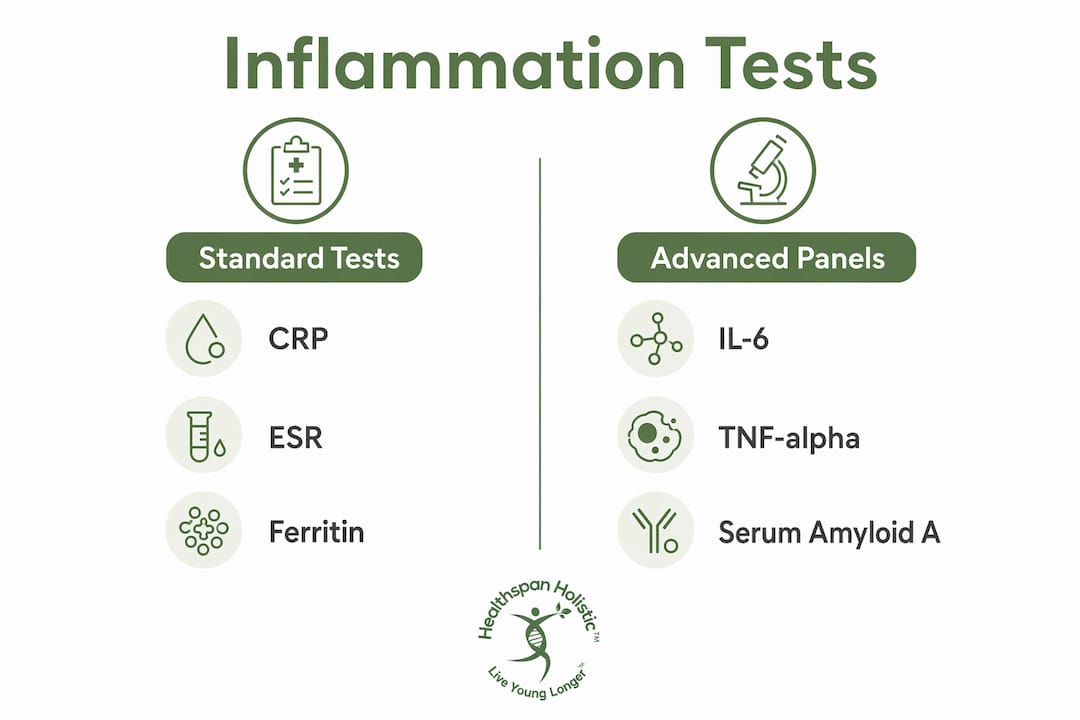
Advanced panels include markers such as IL-6, TNF-alpha, fibrinogen, serum amyloid A, and metabolic markers. These cytokines are the chemical messengers your immune cells use to communicate. Elevated IL-6, for example, is strongly associated with accelerated aging and metabolic dysfunction. Standard CRP will not catch this.
Traditional tests may miss chronic low-grade inflammation that drives conditions like insulin resistance, arterial stiffness, and cognitive decline. Advanced panels fill that gap by looking at nutritional and metabolic contributors alongside immune markers.
| Panel type | Markers included | Best used for |
|---|---|---|
| Standard | CRP, ESR, ferritin | Acute illness, basic monitoring |
| Advanced | IL-6, TNF-alpha, fibrinogen, serum amyloid A, metabolic markers | Chronic low-grade inflammation, longevity planning |
Healthspan Holistic offers a dedicated inflammation panel that goes beyond standard markers to assess your inflammatory and metabolic status together. This is the kind of testing that longevity-focused practitioners use to build a complete picture of your health. For adults who want to understand what is quietly driving inflammation in their body, this level of detail is worth the investment.
Pro Tip: Pair your inflammation panel with a lab testing review that covers your full metabolic and nutritional status. Deficiencies in magnesium, vitamin D, and omega-3 fatty acids all contribute to elevated inflammatory markers.
When and why should you get tested for inflammation?
Knowing when to test is as important as knowing what to test. Inflammation does not always announce itself loudly. Many adults over 45 carry elevated markers for years without obvious symptoms.
Testing is often prompted by symptoms like persistent fatigue, joint pain, unexplained fever, or the presence of a chronic health condition. If you have been feeling run down for months with no clear cause, inflammation testing is a logical first step. For adults managing conditions like rheumatoid arthritis, inflammatory bowel disease, or metabolic syndrome, regular testing helps track whether treatment is working.
Inflammation testing also plays a direct role in cardiovascular risk assessment. Elevated hs-CRP is an independent risk factor for heart attack and stroke, separate from cholesterol levels. If you are in the 45–75 age group and have not had your hs-CRP checked, that is a gap worth closing. Learning about inflammation after 40 can help you understand why this window of time matters so much for prevention.
Questions worth asking your doctor before or after inflammation testing:
- Which specific markers are you ordering and why?
- Should I have hs-CRP tested instead of or alongside standard CRP?
- How often should I retest to track trends?
- What other tests should accompany these results for a complete picture?
- If my markers are elevated, what are the next diagnostic steps?
Normal markers do not always mean no inflammation is present. CRP and ESR results require clinical context to be meaningful. Some forms of chronic low-grade inflammation exist below the detection threshold of standard tests. That is exactly why advanced panels exist and why working with a knowledgeable practitioner matters.
Key takeaways
Inflammation blood tests are most useful when interpreted as part of a broader clinical picture, not as standalone diagnoses.
| Point | Details |
|---|---|
| CRP vs. hs-CRP | Use hs-CRP for cardiovascular and chronic inflammation risk; standard CRP suits acute illness only. |
| ESR is a slow marker | ESR lags 24–48 hours and stays elevated longer, making it better for monitoring than detecting. |
| Results need context | Elevated markers signal immune activity but cannot diagnose a specific condition without clinical correlation. |
| Advanced panels go deeper | IL-6, TNF-alpha, and fibrinogen reveal chronic low-grade inflammation that standard tests miss. |
| Timing matters | Test at least two weeks after any acute illness to get an accurate baseline reading. |
Why I think most adults over 45 are undertested for inflammation
Most people I speak with have had their cholesterol checked dozens of times but have never had an hs-CRP or ESR ordered. That gap is a real problem. Standard CRP is too coarse a tool to catch the slow, quiet inflammation that builds over years and drives cardiovascular disease, cognitive decline, and joint deterioration.
The common misconception is that elevated markers mean you have a specific disease. They do not. Elevated markers reflect active immune activity that requires clinical context to interpret. A single high CRP after a bad cold means very little. A CRP that has been creeping upward over two years, combined with fatigue and joint stiffness, means a great deal.
What I have seen work consistently is combining CRP and ESR with an advanced panel that includes IL-6 and fibrinogen, then tracking results every three to six months. That trend data is where the real insight lives. One reading is a data point. A series of readings is a story.
The other thing worth saying plainly: these tests are not expensive or complicated. They require no fasting, take five minutes, and return results within a day. The barrier is not the test itself. The barrier is knowing to ask for it. If you are over 45 and managing your health proactively, inflammation testing belongs in your regular rotation alongside lipid panels and blood glucose.
— Chris
What Healthspan Holistic offers for inflammation testing
Healthspan Holistic built its testing programs specifically for adults aged 45–75 who want more than a basic annual checkup. The Inflammation Panel covers both standard and advanced markers, giving you a complete view of your inflammatory status.
For a fully integrated approach, the 90 Day Journey to Longevity combines comprehensive lab testing, including inflammation markers, with personalized health coaching to help you act on what your results reveal. The Healthspan Holistic team walks you through your results and helps you build a plan around nutrition, supplementation, and lifestyle adjustments.
1st Time Customers can take advantage of our BUY 1 GET 1 50% OFF special offer on all supplements.
FAQ
What is the most accurate blood test for inflammation?
hs-CRP is the most sensitive standard marker for detecting chronic low-grade inflammation linked to cardiovascular risk. For a complete picture, advanced panels that include IL-6, TNF-alpha, and fibrinogen provide deeper insight.
Do I need to fast before an inflammation blood test?
No fasting is required for standard inflammation tests like CRP and ESR. Results are typically available within 24 hours of the blood draw.
Can inflammation blood tests diagnose a specific disease?
No. Inflammation markers indicate that your immune system is active but cannot identify the cause on their own. A clinician interprets results alongside your symptoms and other diagnostic tests.
How often should adults over 45 test for inflammation?
Testing every three to six months is appropriate for adults managing chronic conditions or tracking trends. Annual testing is a reasonable baseline for adults focused on prevention.
What causes elevated inflammation markers without obvious symptoms?
Low-grade chronic inflammation from metabolic syndrome, poor diet, sleep disruption, or early-stage cardiovascular disease can elevate markers without noticeable symptoms. Advanced panels are better suited to detecting these hidden drivers.
Leave a comment: