

TL;DR:
- The body needs at least 130 grams of carbohydrates daily to support brain and nervous system functions. For adults over 45, choosing high-quality, fiber-rich carbs from whole foods is essential for maintaining health and preventing age-related decline. Personalized carbohydrate intake based on activity and metabolic health better supports long-term wellness than strict or fixed limits.
Carbohydrates are defined as the body’s primary fuel source, providing glucose that powers every cell, organ, and thought you have. The question of whether the body needs carbs has a clear answer: yes, and the science behind it matters more as you age. The Institute of Medicine sets the minimum Recommended Dietary Allowance (RDA) for carbohydrates at 130 grams per day for all adults, specifically to support brain and nervous system function. For adults between 45 and 75, getting carbohydrate intake right is not just about energy. It directly shapes cognitive sharpness, metabolic health, and how well you age. This article breaks down how much you need, what happens when you cut too low, and why the quality of your carbs matters far more than most people realize.
Does the body need carbs, and how much is enough?
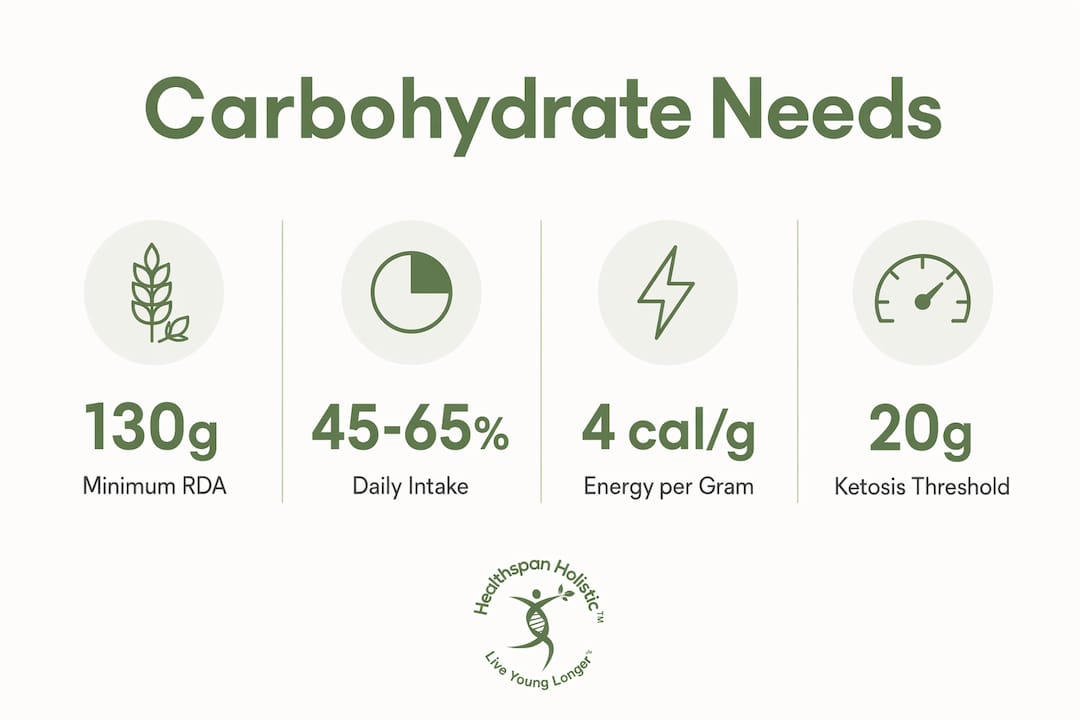
The short answer is yes, and the amount matters. The minimum RDA of 130 grams per day supplies roughly 520 calories, covering about 25% of a standard 2,000-calorie diet. That floor exists because your brain and red blood cells run almost exclusively on glucose. Cut below it, and your body starts compensating in ways that create metabolic stress.

The broader recommendation goes further. The Dietary Guidelines for Americans recommend that 45–65% of your total daily calories come from carbohydrates. On a 2,000-calorie diet, that translates to 225–325 grams per day. That range gives your body enough glucose to fuel physical activity, support gut health through fiber, and maintain steady energy throughout the day.
Each gram of carbohydrate delivers 4 calories of energy. Protein delivers the same amount, while fat delivers more than double at 9 calories per gram. Carbohydrates, however, convert to glucose faster and more efficiently, making them the preferred fuel for high-demand tissues like the brain.
| Daily calorie intake | 45% carbs (grams) | 65% carbs (grams) |
|---|---|---|
| 1,600 calories | 180g | 260g |
| 2,000 calories | 225g | 325g |
| 2,400 calories | 270g | 390g |
For adults over 45, metabolism slows and muscle mass tends to decline. That shift means your carbohydrate needs may sit closer to the lower end of the range, especially if you are less active. The key is not slashing carbs entirely. It is choosing the right ones and matching intake to your actual energy output.
Pro Tip: Track your energy levels across the day for one week. Consistent afternoon fatigue often signals that your carbohydrate intake is too low or poorly timed, not that carbs are the problem.
What happens when you cut carbs too low?
When carbohydrate intake drops below roughly 20 grams per day, the body enters ketosis. Ketosis is a metabolic state where the liver converts fat into ketone bodies to use as fuel. It is a survival mechanism, not a preferred operating mode. The brain requires glucose as its optimal fuel, and ketones are a backup, not an upgrade.
Short-term, very low-carb diets (60–130 grams per day) can produce weight loss. That result is real. The problem is durability. Research shows that the metabolic benefits of very low-carb diets often do not hold beyond 12–24 months. Most people regain weight once they return to normal eating patterns.
For adults over 45, the risks of severe carb restriction carry additional weight:
-
Cognitive fog: The brain consumes roughly 20% of the body’s total energy. Reducing glucose supply can impair memory, focus, and reaction time.
-
Muscle loss: Without adequate carbohydrates, the body may break down muscle protein for glucose through a process called gluconeogenesis. Muscle loss accelerates naturally after 45, so this compounds the problem.
-
Nutrient gaps: Very low-carb diets risk nutrient inadequacy and are not recommended without medical supervision, particularly for people managing diabetes, kidney disease, or cardiovascular conditions.
-
Gut health decline: Fiber comes almost entirely from carbohydrate-rich foods. Cutting carbs sharply reduces fiber intake, which disrupts the gut microbiome and raises the risk of constipation and inflammation.
-
Energy instability: Ketone production creates metabolic stress. Many people report fatigue, irritability, and poor sleep during the adaptation phase, sometimes lasting weeks.
Pro Tip: If you are curious about a lower-carb eating pattern, explore the keto-Mediterranean approach rather than strict ketosis. It preserves fiber and micronutrient intake while moderating carb load.
Why carbohydrate quality matters more than quantity
Not all carbohydrates work the same way in your body. The distinction between complex and simple carbohydrates is the single most important concept in practical nutrition for adults over 45.
Complex carbohydrates deliver fiber, vitamins, and minerals that simple sugars simply do not contain. Whole grains, legumes, vegetables, and fruits provide nutrients that protect against chronic disease. Refined carbohydrates, like white bread, sugary drinks, and packaged snacks, deliver calories without those protective nutrients. That gap matters enormously for long-term health.
| Carbohydrate type | Examples | Key benefits |
|---|---|---|
| Complex (whole food) | Oats, lentils, sweet potato, brown rice | Fiber, B vitamins, minerals, slow glucose release |
| Simple (natural) | Fruit, dairy | Vitamins, antioxidants, moderate sugar load |
| Simple (refined) | White bread, soda, candy | Fast energy only, no fiber or micronutrients |
Fiber-rich carbohydrates promote gut health, support cholesterol management, and reduce the risk of obesity and type 2 diabetes. These benefits are especially significant for adults aged 45–75, who face rising risk for all three conditions. The gut microbiome, which depends heavily on fiber as its food source, also plays a direct role in immune function and mood regulation.
The practical priorities for nutrient-dense carbohydrate choices include:
-
Whole grains like oats, quinoa, and barley over white rice or white bread
-
Legumes like lentils, chickpeas, and black beans, which combine fiber with plant protein
-
Colorful vegetables like broccoli, carrots, and leafy greens for micronutrients and antioxidants
-
Whole fruits over fruit juice, which strips out fiber and concentrates sugar
Understanding refined sugars versus nutrient-dense carbs is one of the clearest ways to protect your healthspan. The goal is not to fear carbohydrates. It is to make them work harder for your health. You can read more about how fiber supports health specifically for adults in the 45–75 range.
How do individual factors shape your carbohydrate needs?
Carbohydrate needs are not one-size-fits-all. Nutrition experts confirm there is no universal upper limit for carbohydrate intake. The right amount depends on your activity level, metabolic health, age, and personal goals.
Here is a practical framework for thinking about your own needs:
-
Assess your activity level. A person walking 30 minutes daily has different fuel demands than someone doing strength training four times per week. More movement means more glucose demand, which means more room for carbohydrates in your diet.
-
Factor in your metabolic health. Adults managing type 2 diabetes or insulin resistance benefit from moderating carbohydrate intake and prioritizing low-glycemic sources. A healthcare provider or registered dietitian can help you set a target that keeps blood sugar stable without unnecessary restriction.
-
Watch your energy markers. Persistent fatigue, brain fog, or poor workout recovery can all signal that your carbohydrate intake needs adjusting. These are real physiological signals, not just feelings.
-
Consider cognitive support. Carbohydrates play a direct role in brain and nervous system function. Adults over 45 who notice memory lapses or difficulty concentrating should evaluate whether their diet is supplying enough glucose for optimal brain performance.
-
Get your metabolic markers tested. Fasting glucose, HbA1c, and triglyceride levels all reflect how your body is handling carbohydrates. A metabolic panel gives you concrete data to guide your nutrition decisions rather than relying on guesswork.
The shift in modern nutrition science moves away from fixed carbohydrate limits toward personalized intake based on lifestyle and health status. That approach keeps energy stable, supports long-term wellness, and avoids the pitfalls of both excess and restriction.
Key Takeaways
The body requires a minimum of 130 grams of carbohydrates per day to fuel the brain and nervous system, and carbohydrate quality determines whether those grams protect or undermine long-term health.
| Point | Details |
|---|---|
| Minimum RDA is 130g per day | This floor supports brain and nervous system function in all adults. |
| Aim for 45–65% of calories from carbs | For a 2,000-calorie diet, that equals 225–325 grams daily. |
| Carb quality outweighs quantity | Complex carbs from whole foods deliver fiber and micronutrients that refined carbs lack. |
| Low-carb risks rise after 45 | Severe restriction can accelerate muscle loss, cognitive fog, and nutrient gaps. |
| Personalize your intake | Activity level, metabolic health, and lab results should guide your carbohydrate target. |
Carbs, aging, and what I’ve learned from working with adults over 45
The most persistent myth I encounter is that carbohydrates are the enemy of healthy aging. People come in having cut carbs dramatically, often inspired by trending diet advice, and they feel worse. They are tired, mentally sluggish, and frustrated that the promised results have not arrived.
What the science actually shows is that the problem is almost never carbohydrates themselves. It is the type of carbohydrates and the mismatch between intake and individual need. I have seen adults in their 60s restore their energy and sharpen their thinking simply by swapping refined carbs for whole grains and legumes, without reducing total carbohydrate intake at all.
The cognitive angle is the one that surprises people most. Carbohydrates are not just fuel for your muscles. They are the primary energy source for your brain. When you chronically under-fuel with glucose, the mental effects accumulate quietly. You may not notice the decline until you compare how you feel after a few weeks of eating well.
My practical advice: do not chase a number. Chase quality. Get your metabolic markers tested, understand your personal baseline, and build a carbohydrate strategy around whole foods and your actual energy demands. That approach holds up far better than any trend.
— Chris
Healthspan Holistic and your nutrition foundation
Understanding carbohydrate needs is one piece of a larger picture. Healthspan Holistic offers personalized lab testing and coaching to help you see exactly how your body is processing nutrients right now.

The 90 Day Journey to Longevity program combines detailed blood panels, metabolic tracking, and one-on-one coaching to build a nutrition plan that fits your biology. A metabolic panel can reveal how your body handles glucose and carbohydrates at a cellular level, giving you real data instead of guesswork. 1st Time Customers can take advantage of our BUY 1 GET 1 50% OFF special offer on all supplements.
FAQ
What is the minimum carbohydrate intake the body needs?
The minimum RDA for carbohydrates is 130 grams per day for all adults. This amount supplies enough glucose to support brain and nervous system function.
Do humans need carbohydrates to survive?
The body can survive in ketosis without carbohydrates, but glucose remains the preferred fuel for the brain and red blood cells. Survival and optimal function are not the same thing.
Are carbs necessary for health after age 50?
Yes. Fiber-rich carbohydrates/02%3A_Module_Energy_and_Macronutrients/2.02%3A_Carbohydrates/2.2.01%3A_Introduction_to_Carbohydrates) reduce the risk of obesity, type 2 diabetes, and cardiovascular disease, all of which become more relevant after 50. Cutting carbs too low can accelerate muscle loss and cognitive decline.
What happens without carbs for an extended period?
Very low-carb diets may produce short-term weight loss, but metabolic benefits often fade after 12–24 months. Long-term restriction without medical supervision also risks nutrient inadequacy.
How do I know if my carbohydrate intake is right for me?
Monitoring fasting glucose, HbA1c, and energy levels gives you the clearest picture. A personalized approach based on your activity level, metabolic health, and lab results is more reliable than following a fixed carbohydrate rule.
Leave a comment: