

TL;DR:
Choosing lab tests that lead to actionable health decisions is essential, especially for adults aged 45 to 75.
Verified panels, certified labs, and consistent testing strategies ensure reliable results you can trust over time.
Choosing the right lab tests is defined by one principle: every test you order should lead to a decision you can act on. For adults aged 45–75, knowing how to choose lab testing means matching your personal health goals with validated panels, certified labs, and results you can actually use. Two federal and professional standards anchor quality in the U.S.: CLIA certification and CAP accreditation. Direct-to-consumer labs now make testing more accessible than ever, but access without quality vetting can do more harm than good. Understanding terms like lipid panel, CBC, and metabolic panel gives you the vocabulary to have better conversations with your care team and make smarter choices.
What key health markers should adults aged 45–75 consider?
The core panels for this age group cover the widest ground with the fewest draws. A complete blood count (CBC), comprehensive metabolic panel (CMP), lipid profile, and thyroid panel form the foundation of any preventive screening strategy. Annual screening for these markers catches early biomarker shifts before chronic diseases take hold. That early warning is exactly why consistent testing matters more than any single result.
Beyond the basics, several additional markers deserve attention as you move through your 50s and beyond:
-
Glucose and HbA1c: Tracks blood sugar trends and insulin sensitivity over three months.
-
Inflammatory markers (hs-CRP, homocysteine): Elevated levels link to cardiovascular and cognitive risk.
-
Sex hormone panels (testosterone, estradiol, DHEA-S): Hormonal shifts after 45 affect energy, mood, bone density, and body composition.
-
Vitamin D and B12: Deficiencies are common in this age group and directly affect fatigue, immunity, and nerve function.
-
Ferritin: A better iron marker than serum iron alone, and often missed in standard panels.
Functional lab testing goes one step further. Rather than simply flagging disease, functional panels identify markers tied to evidence-based lifestyle and nutrition interventions. The goal is not to chase perfect numbers. The goal is to find what you can change.
Pro Tip: Before ordering any test, ask yourself: “If this result comes back abnormal, what will I do differently?” If the answer is nothing, skip the test.

How do you evaluate and select quality labs?
Lab quality is not uniform, and the difference matters when you are tracking your health over years. CLIA certification is the federal baseline every U.S. lab must meet. CAP accreditation goes further, requiring rigorous peer review, stricter proficiency testing, and ongoing procedure audits. A CAP-accredited lab is a meaningful step above the minimum.
When comparing your options, think across three categories:
-
Hospital labs: Higher cost, often slower batch processing, but useful for urgent or complex cases. A vitamin D test can cost $150 at a hospital lab versus $30 at an independent lab.
-
Independent labs: High-volume, cost-efficient, and widely networked. These handle the majority of routine preventive testing.
-
Direct-access labs: You order online without a physician referral. Costs typically range from $29 to $399, often undercutting high-deductible insurance rates.
Beyond certification and cost, consider these practical factors before committing to a lab:
-
Network consistency: Using the same lab for follow-up tests reduces result variability. Consistent lab use enables more reliable trend analysis over time.
-
Turnaround time: Most routine panels return results within 24–72 hours at independent labs.
-
Insurance and cash-pay options: Know what your plan covers and what the cash price is. Sometimes paying out of pocket is faster and cheaper.
-
Specimen handling: Poor handling between draw and processing skews results. Ask whether the lab uses temperature-controlled transport.
To evaluate whether a lab meets trustworthy wellness standards, look for published accreditation details on their website and verify CLIA numbers through the CMS database.
Step-by-step guide to choosing and ordering the right tests
A clear process removes the guesswork from selecting lab tests. Follow these steps to make confident, cost-effective decisions.
-
Define your health goal. Are you screening for cardiovascular risk, tracking hormone balance, or investigating fatigue? Your goal determines which panel fits.
-
Identify suitable tests. Work with your physician, a health coach, or use validated resources to match your goal to specific markers. The Merck Manual notes that tests ordered without narrowing the diagnosis increase costs and false positives.
-
Compare labs by certification, cost, and convenience. Verify CLIA and CAP status. Compare cash prices. Check whether the lab has a draw site near you or offers mobile phlebotomy.
-
Understand physician-ordered versus direct-to-consumer tests. Physician-ordered tests are typically covered by insurance and come with clinical interpretation. Direct-to-consumer tests offer speed and privacy but require you to seek interpretation separately.
-
Prepare properly before your draw. Fast for 8–12 hours if your panel includes glucose or lipids. Stop biotin supplements 3–7 days before testing to prevent false readings in thyroid, hormone, and cardiac panels.
-
Review results with a qualified expert. A number out of range is not a diagnosis. Context matters. Platforms offering physician review or health coaching add real value here.
-
Use the same lab for follow-up. Switching labs mid-monitoring introduces variability that makes trend analysis unreliable.
Pro Tip: Schedule your blood draw in the morning. Cortisol, testosterone, and several other hormones follow circadian rhythms and peak in the early hours, giving you the most accurate baseline.
Common mistakes to avoid when selecting lab tests
Ordering too many tests at once is the most common mistake adults make when they first engage with preventive health. Unnecessary optimization panels without clear action plans generate anxiety and cost without delivering health benefit. A large panel with 50 markers almost always produces a few borderline results, and chasing those results leads to expensive follow-up testing that rarely changes outcomes.
Watch for these specific pitfalls:
-
Switching labs between tests: Result variability across labs can make a stable marker look like it changed when it did not.
-
Ignoring lab certifications: An uncertified or CLIA-only lab without CAP review carries higher risk of inaccurate results.
-
Skipping expert interpretation: Direct-to-consumer results interpreted without clinical context can cause unnecessary alarm over borderline values.
-
Forgetting supplement interference: Biotin is the most documented offender, but high-dose vitamin C and biotin-containing hair supplements also affect certain panels.
-
Testing without a plan: If a result will not change what you eat, how you move, or what you supplement, the test is not serving you.
“Actionability should be the first question before ordering a test. If no realistic clinical or lifestyle change follows a result, the test may add cost and anxiety without benefit.”
Linking every test result to a specific health decision is what separates effective lab monitoring from expensive data collection. The why behind blood testing matters as much as the results themselves.
Key Takeaways
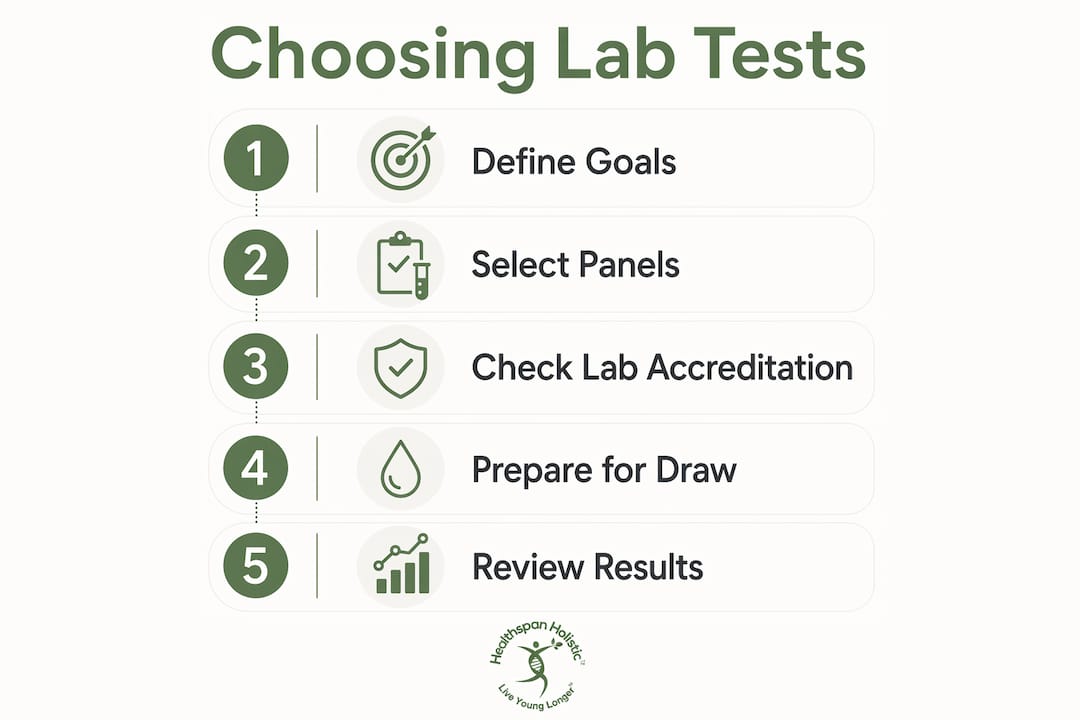
Choosing the right lab tests requires matching your health goals to certified providers, validated panels, and a consistent testing strategy that produces results you can act on.
| Point | Details |
|---|---|
| Prioritize actionable tests | Order only tests that will directly inform a health or lifestyle decision. |
| Verify lab certifications | Look for CLIA certification at minimum; CAP accreditation signals higher quality. |
| Stay consistent with your lab | Using the same lab for follow-up tests ensures reliable trend tracking over time. |
| Prepare before your draw | Stop biotin 3–7 days before testing and fast 8–12 hours for metabolic panels. |
| Interpret results in context | Borderline values need clinical context; always review results with a qualified expert. |
What I have learned from watching people test
People often come to lab testing with one of two mindsets. The first group wants a number to fix. The second group wants a story their body is telling. The second group gets far more value from the process.
I have seen adults order 80-marker panels, receive three borderline results, and spend months anxious about numbers that never required intervention. I have also seen people run a focused six-marker panel, identify a correctable vitamin D deficiency, and feel meaningfully better within 12 weeks. The difference was not the size of the panel. It was the clarity of the question going in.
The most useful thing you can do before any blood draw is write down two sentences: what you want to learn, and what you will do if the result is abnormal. That exercise alone filters out half the unnecessary tests most people order.
Consistency matters more than comprehensiveness. A metabolic panel run at the same certified lab every year tells a far richer story than five different panels run at five different labs over a decade. Trends are the signal. Single data points are just noise.
- Chris
Healthspan Holistic’s approach to lab testing and wellness
Healthspan Holistic makes it straightforward to connect your health goals with the right panels and expert support. The 90 Day Journey to Longevity program pairs detailed lab testing with one-on-one coaching, so your results lead directly to a personalized plan rather than sitting in a folder.

The platform offers targeted panels including the comprehensive hormone panel and metabolic testing, designed for adults who want clarity on what their body is doing and why. Every panel comes with expert review so you are never left interpreting numbers alone. Whether you are starting your first panel or refining a monitoring strategy you have used for years, Healthspan Holistic gives you the tools and the guidance to make your results count.
1st Time Customers can take advantage of our BUY 1 GET 1 50% OFF special offer on all supplements.
FAQ
What is the difference between CLIA and CAP certification?
CLIA is the federal baseline certification required for all U.S. labs to operate legally. CAP accreditation is a voluntary, higher-level standard involving rigorous peer review and ongoing proficiency testing that exceeds CLIA requirements.
Can I order lab tests without a doctor?
Yes. Direct-to-consumer labs allow you to order tests online without a physician referral, with costs typically ranging from $29 to $399. Results are most useful when reviewed with a qualified health professional to provide clinical context.
Which blood tests should adults over 45 get annually?
The core annual panel for adults aged 45–75 includes a CBC, CMP, lipid profile, thyroid panel, glucose or HbA1c, and inflammatory markers. Hormone panels and vitamin D are also worth adding based on your specific symptoms and goals.
Why does it matter which lab I use for follow-up testing?
Different labs use different equipment and specimen handling procedures, which can produce variable results even for the same marker. Staying with the same certified lab ensures your trend data reflects real changes in your health, not lab-to-lab differences.
How do I prepare for a blood draw?
Fast for 8–12 hours before panels that include glucose or lipids, and stop biotin supplements 3–7 days before testing to prevent false readings in thyroid, hormone, and cardiac panels. Schedule your draw in the morning for the most accurate hormone baselines.
Leave a comment: