

TL;DR:
Mitochondria are essential for energy production, cell repair, and overall health.
Lifestyle habits like exercise, sleep, and proper nutrition significantly support mitochondrial health.
Advanced mitochondrial testing is complex; foundational habits remain the most reliable for improving mitochondrial function.
Feeling like your energy has quietly slipped away over the past few years? You are not alone, and more importantly, that fatigue is not simply something you have to accept. While many chalk up low energy, slower recovery, and mental fog to the unavoidable march of time, researchers and holistic health practitioners increasingly point to something far more specific at the root: the health of your mitochondria. These microscopic structures, present in nearly every cell of your body, function as the engine room of your biology. When they run well, you feel it. When they don’t, everything suffers.
Key Takeaways
| Point | Details |
|---|---|
| Mitochondria fuel health | Your cells depend on mitochondria for energy, resilience, and key regulatory functions. |
| Aging impacts mitochondria | Mitochondria quality declines with age and contributes to chronic diseases and inflammation. |
| Lifestyle changes work best | Regular exercise, sleep, and nutrition are most effective for supporting mitochondrial health. |
| Complex tests have limits | Most advanced mitochondrial diagnostics are best reserved for select situations and need expert guidance. |
| Focus on fundamentals | Consistent healthy habits provide the strongest, most reliable way to support your mitochondria and wellness. |
What are mitochondria and why do they matter?
Now that you’re considering new possibilities for health and energy, it’s time to zoom in on what mitochondria actually are and why their role is so foundational.
Mitochondria are often called the “powerhouses of the cell,” and that nickname is well earned. Their primary job is producing adenosine triphosphate (ATP), the molecule your body uses as fuel for virtually every biological process. Muscle contraction, brain activity, immune response, tissue repair — all of it depends on a steady ATP supply. Without well-functioning mitochondria, your cells simply cannot do their jobs effectively.
But ATP production is only part of the story. Mitochondria regulate multiple processes beyond energy, including apoptosis (the orderly death of old or damaged cells) and involvement in many disease processes. Apoptosis is critical for healthy cell turnover. When this process is disrupted, damaged cells that should be cleared away can accumulate, raising the risk of dysfunction throughout the body.
Understanding what holistic health means helps put this into context. Mitochondrial function connects to virtually every organ system because nearly all cells depend on them. Heart muscle cells, neurons, liver cells, and immune cells are especially mitochondria-rich because their energy demands are so high.
“Mitochondria are not just energy factories. They are signaling hubs that influence whether cells live, adapt, or die.”
Here is a quick overview of the key roles mitochondria play:
| Mitochondrial function | What it means for you |
|---|---|
| ATP production | Sustained physical and mental energy throughout the day |
| Apoptosis regulation | Healthy cell turnover and reduced disease risk |
| Calcium signaling | Supports muscle contraction and nerve function |
| Immune signaling | Helps coordinate inflammatory and antiviral responses |
| Hormone synthesis | Supports production of steroid hormones including cortisol |
This broad reach is exactly why mitochondrial health matters so much, especially as you get older. It is not just about energy. It is about resilience, recovery, and how your body handles the daily demands of life.
How mitochondrial health shapes aging and chronic disease
With mitochondria’s central role established, it’s vital to examine how their health declines affect aging and chronic diseases that matter most in midlife and beyond.

As you age, mitochondria become less efficient. They generate more reactive oxygen species (ROS), often called free radicals, and become less effective at repairing themselves. This is not a simple, linear decline. It is more of a downward spiral. Mitochondrial aging leads to decreased energy metabolism, increased ROS production, mitochondrial DNA (mtDNA) mutation accumulation, and amplified oxidative stress and inflammatory pathways.
What makes this particularly important is the feedback loop involved. Damaged mitochondria produce more ROS. Excess ROS damages cellular components, including mitochondria themselves. This triggers inflammatory signaling, which further impairs mitochondrial quality control. The result is a cycle that quietly accelerates biological aging.
This is not just theoretical. Mitochondrial dysfunction is strongly linked to several of the most common and serious health challenges after age 45, including:
-
Cardiovascular disease: Heart muscle cells need enormous amounts of ATP. Impaired mitochondria compromise heart function and increase risk of disease.
-
Type 2 diabetes: Mitochondrial dysfunction in muscle and liver cells impairs glucose metabolism and insulin sensitivity.
-
Alzheimer’s disease: Mitochondrial aging contributes to impaired neuronal bioenergetics, oxidative stress, and neuroinflammation, and is strongly implicated in neurodegenerative diseases including Alzheimer’s and Parkinson’s.
-
Chronic fatigue: When cells cannot produce enough ATP, fatigue becomes systemic and persistent, not the kind a good night’s sleep fixes.
-
Sarcopenia: Age-related muscle loss is closely tied to reduced mitochondrial biogenesis in muscle tissue.
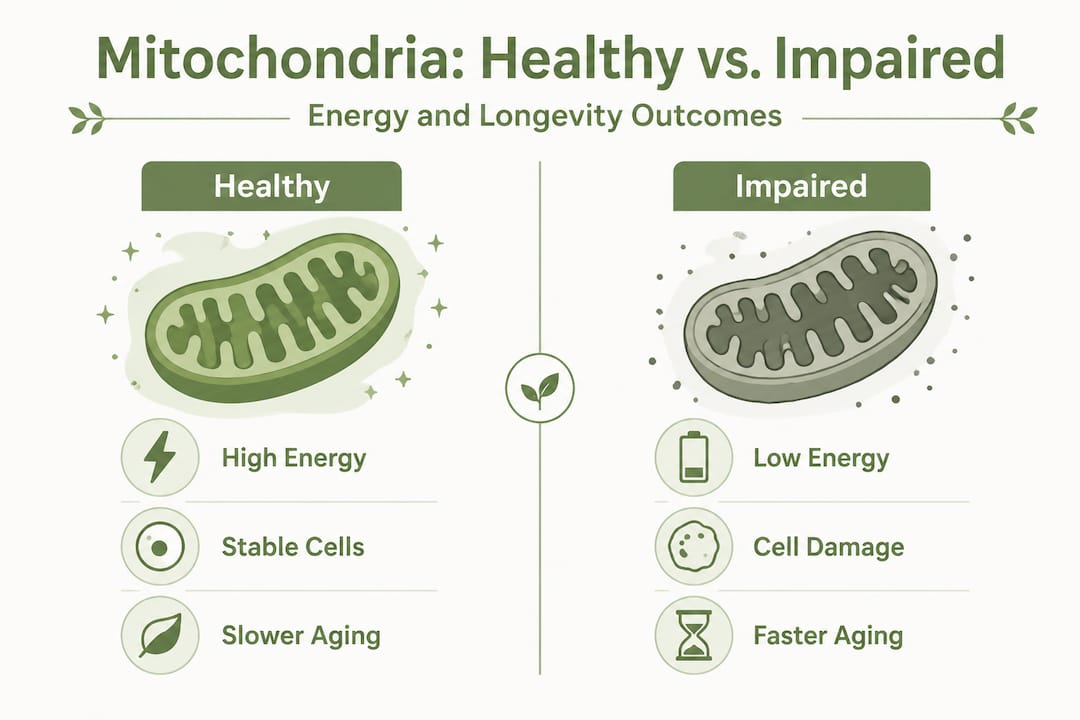
Here is a clearer comparison of what healthy versus impaired mitochondrial function looks like in practice:
| Factor | Healthy mitochondria | Impaired mitochondria |
|---|---|---|
| Energy output | High, consistent ATP production | Low, inconsistent energy supply |
| ROS production | Low, well-controlled | High, triggers cellular damage |
| Inflammation | Regulated, appropriate | Chronic, low-grade inflammation |
| Disease risk | Lower across major chronic conditions | Elevated for heart disease, diabetes, neurodegeneration |
| Cellular repair | Efficient apoptosis and renewal | Accumulation of damaged cells |
Supporting your energy and healthy aging means addressing these mitochondrial pathways directly. It also means paying attention to immune health strategies that reduce the chronic inflammation burdening your mitochondria every day.
Can you slow or reverse mitochondrial decline? What works best
Recognizing the risks of impaired mitochondria, many wonder: is decline inevitable, or can your daily choices truly make a difference? Here’s what the science and expert insights say.
The encouraging answer is yes. Lifestyle choices have a measurable, meaningful impact on mitochondrial health. Exercise and lifestyle inputs are among the most evidence-supported ways to support mitochondrial function and healthspan, influencing mitochondrial biogenesis, dynamics, and quality-control pathways. Biogenesis means your cells actually create new mitochondria, which is something you can stimulate through the right habits.
Here are the most effective steps you can take, ranked by evidence:
-
Engage in regular aerobic exercise. Endurance activities like brisk walking, cycling, or swimming activate a protein called PGC-1 alpha, which is essentially the master switch for mitochondrial biogenesis. Even 30 minutes most days makes a difference. Consistency is more important than intensity for most people over 45.
-
Add resistance training. Strength training prompts mitochondrial adaptations in muscle tissue, improving energy efficiency and metabolic health. It also helps combat sarcopenia, which is closely linked to mitochondrial decline.
-
Prioritize sleep quality. During deep sleep, your cells perform critical mitochondrial maintenance. Chronic sleep deprivation disrupts this repair process, accelerating dysfunction. Targeting 7 to 9 hours of quality sleep is not optional if mitochondrial health matters to you.
-
Eat a nutrient-dense, anti-inflammatory diet. Whole foods rich in antioxidants, B vitamins, magnesium, and coenzyme Q10 support mitochondrial function. Avoiding excess added sugar and ultra-processed foods reduces the metabolic burden on mitochondria.
-
Avoid chronic overeating. Excess caloric intake forces mitochondria to work harder and generates more ROS. Intermittent fasting or simple caloric moderation has shown promise for stimulating mitochondrial cleanup processes, including mitophagy (the recycling of damaged mitochondria).
-
Consider NAD supplementation. NAD (nicotinamide adenine dinucleotide) is a coenzyme that mitochondria depend on to produce ATP. NAD levels naturally decline with age, and supplementing with precursors like NMN (nicotinamide mononucleotide) or NR (nicotinamide riboside) may help support mitochondrial energy metabolism. While the research is still developing, early studies show meaningful potential, particularly for older adults experiencing energy decline.
On the other hand, several habits directly undermine your mitochondria:
-
Chronic psychological stress, which floods your system with cortisol and disrupts mitochondrial function in immune and brain cells
-
Sleep deprivation, which interrupts overnight mitochondrial repair and accelerates damage accumulation
-
Excess sugar intake, which overwhelms mitochondrial processing capacity and increases ROS
-
Sedentary behavior, which reduces the signal to produce new mitochondria
-
Chronic alcohol consumption, which impairs mitochondrial structure in liver cells
Pro Tip: Be cautious about expensive “biohacking” protocols marketed as mitochondrial shortcuts. Infrared saunas, exotic peptides, and certain nootropics are popular but lack the evidence base that exercise, sleep, and diet have accumulated over decades. Start with the fundamentals, and test your blood to identify specific nutrient deficiencies before adding personalized supplementation to your routine.
Personalized approaches and advanced testing: What you need to know
As personalized health technology advances, it’s tempting to look for a test or therapy for every problem. But what does the evidence really support when it comes to mitochondria?
This is where we want to offer you a balanced, honest view. Advanced mitochondrial testing exists, but the field is nuanced. Barriers to personalized mitochondrial therapy are significant: the sheer genetic and clinical complexity of mitochondrial disease, challenges delivering therapies to affected tissues, limited natural-history data, and the need for better outcome measures all slow progress. For rare inherited mitochondrial disorders, even dedicated research teams face these hurdles.
For healthy adults over 45, the picture is different but still nuanced. It is tempting to think that measuring your mtDNA damage or running advanced cellular panels will give you a clear roadmap. Sometimes it does. But often the results are difficult to interpret without specialist guidance, and evidence suggests that some mitochondrial defects, including mtDNA mutations often cited as aging markers, may actually be secondary consequences of declining energy metabolism rather than fundamental drivers. This is an important distinction: it means mitochondrial deterioration can be as much a symptom as a cause.
Watch for these red flags when evaluating mitochondrial health products or test kits:
-
Claims that a single test can “diagnose” your mitochondrial age with precision
-
Supplements promising to completely “reverse” mitochondrial damage without lifestyle change
-
Therapies marketed as cellular-level treatments without peer-reviewed clinical evidence
-
Tests sold directly to consumers that require complex interpretation best handled by a clinician
The most reliable path is to use testing for personalized wellness as one tool in a broader clinical picture. For example, a cellular micronutrient test can reveal whether your cells are deficient in nutrients critical for mitochondrial function, like magnesium, CoQ10, or B vitamins, and that kind of targeted data has real, actionable value.
Pro Tip: For most healthy individuals, a comprehensive blood panel and cellular micronutrient test, interpreted alongside lifestyle data, offers far more actionable insight than expensive standalone mitochondrial tests. Save advanced diagnostics for cases where symptoms persist despite optimized lifestyle habits, and always review results with a qualified health professional.
Our perspective: What really matters for your mitochondrial health
Here is something we have seen play out repeatedly in our practice: people come to us frustrated, having invested in complex tests and exotic supplements, still feeling exhausted and confused. They have tracked their HRV, measured their ketones, and spent real money on “mitochondrial support” stacks. And yet the basics, consistent exercise, quality sleep, whole-food nutrition, and stress management, were never fully prioritized.
Our strong view is that most people do not need more testing. They need more consistency with what we already know works. The lifestyle interventions for mitochondrial health are not glamorous. There is no single supplement or protocol that replaces them. But they are genuinely powerful, and the evidence behind them is far stronger than anything being sold as a cellular shortcut.
That said, we are not dismissing advanced diagnostics entirely. When someone has persistent, unexplained fatigue, neurological symptoms, or a complex health history, targeted testing interpreted by a qualified professional can be transformative. The problem is not testing itself. It is the overuse of tests as a substitute for foundational health habits.
Holistic health foundations remain the most reliable route to improving mitochondrial health for the vast majority of people. That means building a lifestyle that signals to your cells: we are strong, we need energy, we are worth maintaining. Exercise, sleep, real food, and reduced chronic stress. These are not consolation prizes in the absence of a better option. They are the best option, supported by decades of converging research.
We also believe that personalization matters enormously, but that personalization works best when it is built on a foundation of these habits, not used as a substitute for them.
Next steps: Support your mitochondria and wellness journey
Your mitochondrial health is not fixed. It responds to your choices, and the right guidance makes those choices far more targeted and effective.

At Healthspan Holistic, we combine advanced diagnostics, personalized coaching, and professional-grade supplementation to help you build that foundation with precision. If you are ready to stop guessing and start acting on real data, contact us to explore a tailored plan built around your unique biology. You can also order a cellular micronutrient test to identify exactly which nutrients your mitochondria may be missing. And if you are looking to support your journey with evidence-informed products, browse our top wellness supplements, including NAD precursors and mitochondrial support formulas curated for adults over 40.
Frequently asked questions
What are the early signs of poor mitochondrial health?
Early signs often include persistent low energy, muscle weakness, slower post-exercise recovery, and brain fog. Since mitochondria produce essentially all cellular ATP, even partial dysfunction can affect energy, cognition, and physical performance noticeably.
Is mitochondrial dysfunction reversible?
Mitochondrial function can often be significantly improved with regular exercise, better sleep, and anti-inflammatory eating. Exercise and lifestyle inputs rank among the most evidence-supported strategies for stimulating mitochondrial biogenesis and improving cellular energy output.
Should everyone get advanced mitochondrial testing?
Most people do not need advanced mitochondrial tests unless a healthcare professional recommends them for specific, persistent symptoms. Given the barriers to clinical translation of mitochondrial interventions, standard blood panels and nutrient tests often provide more immediately actionable information.
Is mitochondrial DNA damage the main cause of aging?
Current research suggests it is one contributing factor, not the single proven cause. Evidence indicates that some mtDNA damage may actually be a secondary consequence of declining energy metabolism rather than its primary driver, making the relationship more complex than earlier theories suggested.
Can supplements support mitochondrial health?
Certain supplements, including NAD precursors, CoQ10, and magnesium, may help support mitochondrial function, particularly when nutritional gaps exist. That said, exercise and foundational lifestyle habits carry the strongest evidence base and should always come first.
Leave a comment: