

TL;DR:
- Thymosin beta 4 is a naturally occurring peptide that influences tissue repair and inflammation modulation. Although animal studies show promising healing effects, human evidence remains limited and primarily supportive of eye and heart applications. Its unregulated status and lack of FDA approval call for cautious, supervised use, especially since oral options are ineffective.
Thymosin beta 4 (Tβ4) is a naturally occurring 43-amino-acid peptide that regulates actin dynamics, drives cell migration, and modulates inflammation throughout the body. As a thymosin beta 4 supplement, it has attracted serious attention from adults seeking faster recovery, reduced inflammation, and better tissue repair. The World Anti-Doping Agency (WADA) banned Tβ4 in 2011 under its S2 peptide hormones category, which tells you something important: the biology is real enough to concern elite sport regulators. The FDA has not approved any Tβ4 product for therapeutic use as of 2026. That gap between biological promise and regulatory approval is exactly what you need to understand before spending a dollar on this peptide.
What does the science say about thymosin beta 4 benefits?
The preclinical evidence for Tβ4 is genuinely impressive. Animal studies show it accelerates wound closure, promotes new blood vessel formation, and reduces inflammatory markers at the injury site. Specifically, topical Tβ4 application accelerated corneal healing by 32% and reduced neutrophil infiltration by 45% in mice. That level of anti-inflammatory effect is not trivial, and it explains why researchers pursued human trials.
Human clinical data tells a more complicated story. A Phase 2 cardiac trial with 90 participants showed improved cardiac outcomes after intravenous Tβ4 administration. However, a Phase 3 trial targeting corneal healing failed its primary endpoint. That failure matters because it reveals the gap between animal models and human physiology that so often derails peptide research.
The most credible human data supports ophthalmic and cardiovascular applications. Musculoskeletal uses are largely extrapolated from animal studies, not validated human trials. No randomized controlled trials exist for subcutaneous Tβ4 use in tendon, ligament, or muscle injuries, despite widespread off-label use and heavy social media promotion. That is the single most important fact for anyone researching thymosin supplements for recovery.
Pro Tip: When evaluating any peptide research, check whether the study used animal models or human subjects. Animal data is a starting point, not a guarantee. For Tβ4, the human evidence base is still thin for the recovery uses most people care about.
The primary barrier to FDA approval is a lack of validated biomarkers and inconsistent clinical trial results. Tβ4 is biologically protective, but clinical translation struggles to keep pace with the preclinical excitement. That does not mean the science is wrong. It means the science is incomplete.
How does thymosin beta 4 compare with TB-500 and other formulations?
Consumer confusion in this category runs deep. Three distinct product types get lumped together under the “thymosin supplement” label, and they are not interchangeable.
Full-length Tβ4 is the complete 43-amino-acid peptide. It is expensive to synthesize, rarely available in pharmaceutical-grade form outside clinical trials, and the subject of most published research.

TB-500 is a synthetic fragment centered on the active actin-binding domain of Tβ4. It is shorter, cheaper to produce, and more widely available through research chemical suppliers. TB-500 shares many of Tβ4’s healing properties but is a distinct molecule. The two are often conflated in online communities, which creates real problems for anyone trying to interpret research or dosing protocols.
Thymus glandular supplements are a third category entirely. These are traditional supplements made from dried animal thymus tissue. They contain no active Tβ4 peptide in meaningful concentrations. Industry analysts note that marketing frequently conflates these glandular products with research peptides, causing widespread consumer misunderstanding.
| Feature | Full-length Tβ4 | TB-500 | Thymus glandular |
|---|---|---|---|
| Molecule type | 43-amino-acid peptide | Synthetic fragment | Dried tissue extract |
| Active peptide content | Yes | Yes | No |
| Human clinical evidence | Limited (ophthalmic, cardiac) | Minimal | None |
| Production cost | High | Moderate | Low |
| Route of administration | Injectable, topical | Injectable | Oral |
| WADA status | Banned | Banned | Not regulated |
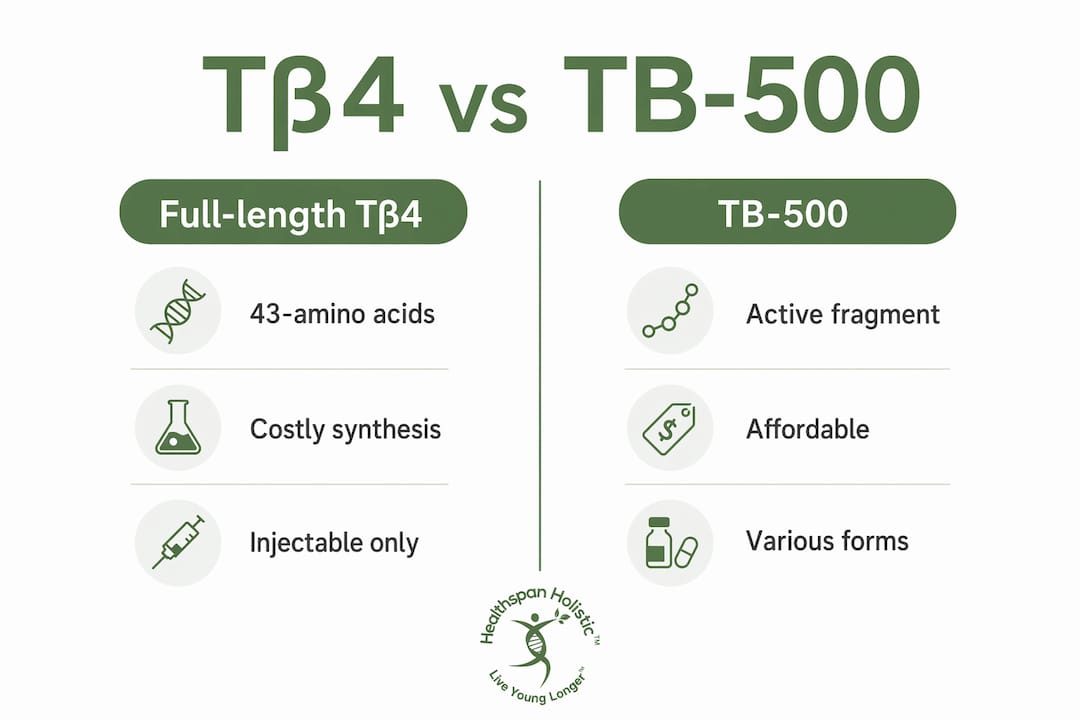
Route of administration is a critical factor that most buyers overlook. Oral Tβ4 products lack scientific evidence of bioavailability because the peptide degrades in the digestive tract before reaching systemic circulation. Studies show negligible peptide survival through oral ingestion in humans. If you see a thymosin beta 4 supplement marketed as a capsule or powder, the active peptide almost certainly does not survive digestion.
For a broader look at how regenerative peptides work in tissue repair, the mechanisms behind Tβ4 fit within a well-established class of compounds worth understanding.
What are the recommended dosage and safety protocols?
Community protocols for subcutaneous TB-500 injections typically use 0.5–2 mg administered three times weekly over a 4–8 week cycle, often preceded by a higher-dose loading phase. These protocols come from online communities, not validated clinical trials. Popular community dosing of 2.0–2.5 mg twice weekly differs markedly from the dosing used in clinical trials for other indications. You are essentially working without a validated map.
Here is what responsible use looks like, based on the available evidence:
- Work with a physician. No reputable dosing protocol exists without medical supervision. A doctor can assess your baseline health, monitor for adverse effects, and help you interpret your response.
- Prioritize pharmaceutical-grade purity. The distinction between pharmaceutical-grade and research-grade peptides is critical. Purity directly impacts both safety and efficacy, yet most consumers never ask for a certificate of analysis.
- Avoid oral formulations. As noted above, oral delivery does not work for intact peptides. Injectable or topical routes are the only forms with any scientific rationale.
- Check your sport’s rules. WADA banned Tβ4 under its S2 category in 2011. Any competitive athlete using this peptide faces disqualification and suspension.
- Do not stack without guidance. Combining Tβ4 or TB-500 with other peptides like BPC-157 is popular experimentally, but experts caution about unknown long-term systemic impacts, particularly related to angiogenesis risks.
Pro Tip: Before you buy thymosin beta 4 or any research peptide, request a third-party certificate of analysis from the supplier. Reputable suppliers provide this without hesitation. If they cannot or will not, walk away.
For adults 35–60 navigating the broader world of peptide therapy, this 2026 guide covers the medical cautions and experimental status of combining multiple peptides in detail.
What benefits and limitations should you realistically expect?
Tβ4’s biology supports several potential benefits that are worth taking seriously, even if the human evidence is still catching up.
- Wound healing acceleration. The 32% improvement in corneal repair from preclinical data suggests real tissue-repair activity, even if human musculoskeletal data is absent.
- Inflammation reduction. The 45% reduction in neutrophil infiltration in animal models points to meaningful anti-inflammatory effects at the cellular level.
- Angiogenesis support. Tβ4 promotes new blood vessel formation, which is central to tissue regeneration after injury.
- Cardiac protection. Phase 2 human data supports some cardiac benefit from intravenous administration, though this is far from a consumer application.
The limitations are equally real and deserve equal weight.
“The most robust human data for thymosin beta 4 supports ophthalmic and cardiovascular applications. For the musculoskeletal recovery uses that most consumers want, the evidence is almost entirely extrapolated from animal studies. No randomized controlled trials validate subcutaneous use for tendon, ligament, or muscle injuries.”
Unregulated product variability adds another layer of risk. You cannot know what you are actually getting from a research chemical supplier without independent testing. Experimental peptide stacks carry unknown long-term risks, particularly around uncontrolled angiogenesis. And the absence of FDA approval means no standardized manufacturing oversight applies to most products on the market.
The honest picture is this: Tβ4 has real biological activity, promising preclinical data, and a handful of encouraging human trials. It also has a failed Phase 3 trial, no validated musculoskeletal protocol, and a largely unregulated supply chain. For anyone researching BPC-157 alongside Tβ4, the same evidence gap applies to stacking these compounds. Understanding peptide safety considerations before committing to any protocol is time well spent.
Key Takeaways
Thymosin beta 4 shows genuine biological promise for tissue repair and inflammation reduction, but the human clinical evidence for musculoskeletal recovery remains too limited to support unsupervised use.
| Point | Details |
|---|---|
| Preclinical evidence is strong | Animal studies show 32% faster wound healing and 45% less inflammation, but human data is limited. |
| TB-500 is not the same as Tβ4 | TB-500 is a synthetic fragment with similar properties but distinct biology and lower production cost. |
| Oral supplements do not work | Peptides degrade in the digestive tract; only injectable or topical routes have scientific rationale. |
| WADA bans Tβ4 | Competitive athletes face disqualification; the ban signals real biological activity, not just caution. |
| Medical supervision is non-negotiable | No validated human dosing protocol exists for musculoskeletal use without physician oversight. |
My honest assessment of thymosin beta 4 in 2026
I have watched the peptide space evolve for years, and Tβ4 is one of the most fascinating and most misrepresented compounds in it. The biology is not hype. A peptide that regulates actin dynamics, drives cell migration, and modulates inflammation is doing something real. The preclinical data is some of the cleanest I have seen in this category.
What concerns me is the gap between that biology and what people actually buy. Most products marketed as thymosin beta 4 supplements are either glandular extracts with no active peptide, oral formulations that cannot survive digestion, or research chemicals of unknown purity. The people most likely to benefit from this science are the least likely to access it safely.
The failed Phase 3 corneal trial is a useful reminder that biology does not always translate. We do not yet have the validated biomarkers to predict who will respond, at what dose, or through what mechanism. That is not a reason to dismiss Tβ4. It is a reason to approach it with the same rigor you would apply to any experimental therapy.
My practical advice: if you are serious about recovery and inflammation, build your foundation first. Get your labs done. Understand your baseline. Work with a physician who knows peptide therapy. The people I have seen get the most from compounds like Tβ4 are those who combine it with a structured recovery plan, not those who treat it as a standalone fix.
— Chris
Healthspan Holistic and your recovery foundation
If Tβ4 research has you thinking seriously about recovery and inflammation, the right next step is building the health foundation that makes any advanced protocol work better.
At Healthspan Holistic, we pair professional-grade supplement support with detailed lab testing so you know exactly where your body stands before adding anything new. Our 90 Day Journey to Longevity gives you a structured, evidence-based program covering recovery, inflammation, and vitality, with personalized coaching built in. You can also run a comprehensive hormone panel to establish your baseline before starting any peptide protocol. 1st Time Customers can take advantage of our BUY 1 GET 1 50% OFF special offer on all supplements. Start with the data, then build the plan.
FAQ
What is thymosin beta 4 used for?
Thymosin beta 4 is studied for wound healing, inflammation reduction, and tissue repair. The strongest human evidence supports ophthalmic and cardiovascular applications, while musculoskeletal uses remain largely based on animal data.
Is thymosin beta 4 legal to buy?
Tβ4 and TB-500 are not FDA-approved for therapeutic use and are sold only as research chemicals in the United States. WADA bans both under its S2 peptide hormones category, making them prohibited for competitive athletes.
What is the difference between Tβ4 and TB-500?
TB-500 is a synthetic fragment of the full-length Tβ4 peptide, centered on its active actin-binding domain. It shares similar healing properties but is a distinct, shorter molecule that is less expensive to produce.
Do oral thymosin beta 4 supplements work?
No. Oral Tβ4 products lack evidence of bioavailability because the peptide degrades in the digestive tract before reaching systemic circulation. Injectable or topical delivery is required for any meaningful biological effect.
What are the main thymosin beta 4 side effects?
Phase 1 and 2 human trials report a generally acceptable safety profile at tested doses. The primary concerns involve unknown long-term angiogenesis effects, risks from unregulated product purity, and compounded risks when stacking Tβ4 with other peptides like BPC-157.
Leave a comment: