

TL;DR:
- Tirzepatide achieves greater average weight loss than semaglutide in clinical trials. However, semaglutide has more mature evidence for reducing cardiovascular events, shaping most treatment choices. Both drugs require careful monitoring of side effects, metabolic markers, and personalized strategies to optimize long-term results.
Tirzepatide produces larger average weight loss than semaglutide, but semaglutide holds the most mature randomized evidence for reducing cardiovascular events. That single trade-off shapes almost every clinical conversation about these two medicines. In the SURMOUNT-5 head-to-head trial published in the New England Journal of Medicine, tirzepatide (Zepbound/Mounjaro family) achieved a mean weight loss noticeably greater than that for semaglutide (Wegovy/Ozempic family) at 72 weeks in adults with obesity. The Cleveland Clinic and the Obesity Medicine Association both frame the choice around primary clinical goal, not a universal winner.
-
Tirzepatide showed notably greater weight loss than semaglutide in the only direct head-to-head randomized trial (SURMOUNT-5, 72 weeks).
-
In the SURPASS-2 trial, tirzepatide reduced A1c more than semaglutide 1 mg at 40 weeks across the doses tested.
-
Semaglutide’s SELECT, SUSTAIN-6, and PIONEER-6 trials demonstrated a reduction in major adverse cardiovascular events (MACE); tirzepatide’s cardiovascular outcome trial data are still maturing.
Take this evidence to a clinician before making any treatment decision. Individual response, comorbidities, and insurance access all shape which medicine is right for you.
How semaglutide and tirzepatide compare at a glance
| Dimension | Semaglutide (Wegovy / Ozempic) | Tirzepatide (Zepbound / Mounjaro) |
|---|---|---|
| Weight-loss efficacy | Mean loss favoring tirzepatide in SURMOUNT-5 (72 wks) | Mean loss favoring tirzepatide in SURMOUNT-5 (72 wks) |
| A1c reduction (T2D) | Larger than placebo; less than tirzepatide at equivalent doses | Superior to semaglutide 1 mg at 40 wks (SURPASS-2) |
| CV outcome evidence | SELECT, SUSTAIN-6, PIONEER-6 — MACE reduction demonstrated | SURPASS-CVOT ongoing; favorable cardiometabolic risk factors |
| Side-effect profile | GI-dominant (nausea, vomiting, diarrhea); thyroid/pancreatitis warning | Similar GI profile; same thyroid/pancreatitis boxed warning |
| Dosing / titration | Weekly SC injection; 0.25 mg → 2.4 mg (Wegovy) over ~16 wks | Weekly SC injection; 2.5 mg → 15 mg over ~20 wks |
| FDA approvals | T2D (Ozempic), obesity (Wegovy), CV risk reduction (Wegovy) | T2D (Mounjaro), obesity (Zepbound) |
| Cost / coverage | Wegovy ~$1,300–$1,400/month cash; Novo Nordisk savings card available | Zepbound ~$1,000–$1,100/month cash; Eli Lilly savings card available |
| Patient suitability | Established ASCVD, pregnancy planning (avoid both), renal impairment | Max weight/glycemic goal, T2D without dominant CV concern |
Key stat: The SURMOUNT-5 trial is the only published randomized head-to-head comparison of these two molecules for obesity. Tirzepatide’s advantage held across all responder thresholds tested.
Three practical takeaways from the table:
-
Tirzepatide wins on average weight loss and glycemic control across the trials available.
-
Semaglutide is the stronger choice when proven MACE reduction is the primary goal.
-
Cost and insurance access often determine which drug a patient can actually start, regardless of trial rankings.
Why the two mechanisms produce different results
Semaglutide is a selective GLP-1 receptor agonist. It mimics glucagon-like peptide-1, a gut hormone that stimulates insulin secretion, suppresses glucagon, slows gastric emptying, and reduces appetite through hypothalamic signaling. That single-receptor action is well-characterized and forms the basis of the entire GLP-1 drug class. You can read a deeper breakdown of GLP-1 biology and risks on the Healthspan Holistic blog.
Tirzepatide adds a second receptor target: GIP (glucose-dependent insulinotropic polypeptide). GIP receptors are expressed in fat tissue, the brain, and the pancreas. Activating both GIP and GLP-1 receptors appears to produce additive effects on satiety signaling and insulin response, which likely explains why tirzepatide consistently outperforms semaglutide on weight and glycemic outcomes in head-to-head data, according to the Frontiers in Medicine 2026 review. Individual response still varies considerably, so dual agonism is not a guarantee of greater benefit for every patient.
Mechanism-linked clinical considerations:
-
Both drugs slow gastric emptying, which drives most GI side effects and can affect absorption of oral medications.
-
Dual GIP/GLP-1 activation may improve insulin sensitivity in fat tissue beyond what GLP-1 alone achieves.
-
Appetite suppression through central (brain) pathways is shared by both; tirzepatide’s GIP component may add a complementary satiety signal.
-
Patients with gastroparesis or slow gut motility face amplified risk with either drug, but particularly with tirzepatide.
Weight-loss evidence: what the head-to-head trials actually show
The SURMOUNT-5 trial is the definitive reference point. Adults with obesity (no T2D) were randomized to tirzepatide or semaglutide for 72 weeks. Tirzepatide produced a mean weight loss of 20.2% versus 13.7% for semaglutide. That gap is not trivial: at a starting weight of 250 lbs, it translates to roughly 16 lbs more lost on tirzepatide.
| Trial | Population | Duration | Tirzepatide result | Semaglutide result |
|---|---|---|---|---|
| SURMOUNT-5 | Obesity, no T2D | 72 weeks | −20.2% body weight | −13.7% body weight |
| SURPASS-2 | Type 2 diabetes | 40 weeks | −20.2% (15 mg) | −13.7% (1 mg) |
| STEP 1 (semaglutide) | Obesity, no T2D | 72 weeks | — | −13.7% (2.4 mg) |
| SURMOUNT-1 (tirzepatide) | Obesity, no T2D | 72 weeks | −20.2% (15 mg) | — |
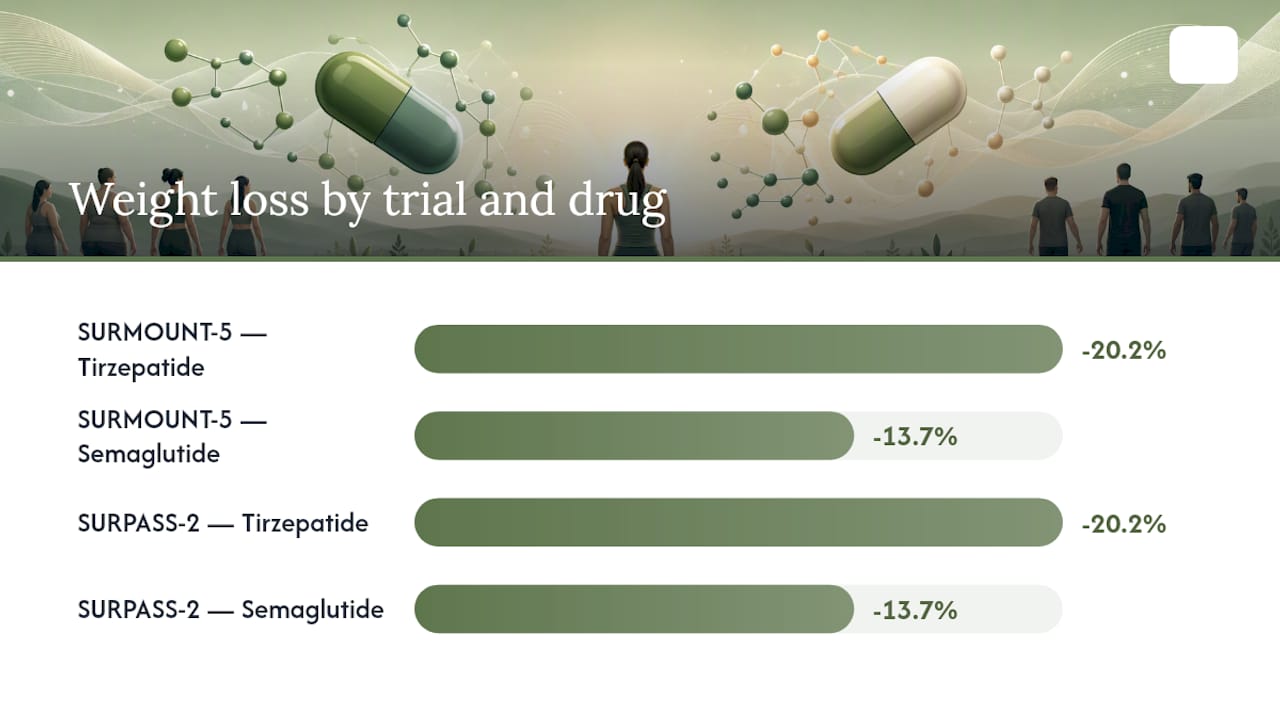
An adjusted indirect treatment comparison confirms that tirzepatide doses from 5 mg to 15 mg outperform semaglutide 2 mg or 2.4 mg on both glycemic and weight outcomes when pooled across trials. One important caveat: SURPASS-2 compared tirzepatide against semaglutide 1 mg (a diabetes dose), not the higher 2.4 mg obesity dose, so the glycemic gap may be somewhat narrower at maximum doses.
Responder-rate highlights:
-
In SURMOUNT-5, a greater proportion of tirzepatide patients achieved ≥20% and ≥25% weight loss thresholds than semaglutide patients.
-
Most patients on either drug see meaningful weight change by weeks 12–16; the largest separation between the two drugs tends to emerge after week 36.
-
Real-world adherence and titration speed affect outcomes significantly. Trial conditions represent best-case persistence.
Glycemic control: A1c reductions and diabetes approvals
For patients with type 2 diabetes, the SURPASS-2 trial showed tirzepatide was both noninferior and superior to semaglutide 1 mg for A1c reduction at 40 weeks. The results were dose-dependent: higher tirzepatide doses produced larger A1c drops. Tracking your own glucose response during therapy is one of the most practical ways to gauge early progress, and understanding why blood sugar monitoring matters can help you stay on top of those shifts.
Key glycemic data points:
-
Tirzepatide 15 mg reduced A1c by approximately 2.3 percentage points in SURPASS-2; semaglutide 1 mg reduced it by approximately 1.9 percentage points.
-
A higher proportion of tirzepatide-treated patients reached an A1c below 7.0% (the standard glycemic target) compared with semaglutide.
-
Both molecules carry FDA approval for type 2 diabetes management (Ozempic for semaglutide; Mounjaro for tirzepatide).
-
Wegovy (semaglutide 2.4 mg) and Zepbound (tirzepatide) carry obesity-specific FDA labels, which affects payer coverage pathways.
-
Neither drug is approved for type 1 diabetes; hypoglycemia risk is low when used without insulin or sulfonylureas.
When glycemic control is the primary goal, tirzepatide’s dose-response advantage is consistent across the available trial data.
Cardiovascular outcomes: where semaglutide still leads
Semaglutide’s cardiovascular evidence is more mature. The SELECT trial demonstrated that semaglutide 2.4 mg reduced MACE (heart attack, stroke, cardiovascular death) in adults with obesity and established cardiovascular disease but without diabetes. SUSTAIN-6 and PIONEER-6 added supporting MACE data in T2D populations. That body of evidence is why major guidelines and the Frontiers in Medicine 2026 review position semaglutide as the preferred choice when proven cardiovascular event reduction is the primary clinical goal.
Tirzepatide’s SURPASS-CVOT trial is ongoing, and dedicated cardiovascular outcome data are not yet available. Tirzepatide does produce favorable changes in blood pressure, LDL cholesterol, and triglycerides, all of which reduce cardiometabolic risk. But favorable risk-factor changes are not the same as a demonstrated reduction in hard cardiovascular events in a randomized trial.
Practical implications:
-
Prioritize semaglutide when the patient has established ASCVD and the primary goal is reducing the risk of a future heart attack or stroke.
-
Tirzepatide’s cardiometabolic risk-factor improvements (BP, lipids, weight) are clinically meaningful but not yet backed by a dedicated MACE outcome trial.
-
Cross-trial comparisons of cardiovascular data are unreliable; patient populations, background therapies, and follow-up periods differ too much to draw direct conclusions.
-
For patients with T2D and high cardiovascular risk, a cardiologist or endocrinologist should weigh in on the choice. A basic heart health test can help establish your cardiometabolic baseline before starting therapy.
Side effects, safety warnings, and what to watch for
Both drugs share a similar adverse-event profile because both slow gastric emptying and activate overlapping satiety pathways. GI symptoms are the most common reason patients reduce doses or discontinue early.
Common adverse events (reported in pivotal trials):
-
Nausea (most frequent, especially during dose escalation)
-
Vomiting, diarrhea, constipation
-
Decreased appetite and early satiety
-
Injection-site reactions (mild, transient)
Serious risks and boxed warnings (both drugs):
-
Thyroid C-cell tumors observed in rodent studies; both carry an FDA boxed warning. Avoid in patients with a personal or family history of medullary thyroid carcinoma (MTC) or multiple endocrine neoplasia type 2 (MEN2).
-
Pancreatitis: discontinue if acute pancreatitis is suspected.
-
Gallbladder disease: cholelithiasis and cholecystitis reported; rapid weight loss increases gallstone risk.
-
Acute kidney injury secondary to severe dehydration from GI losses.
-
Hypoglycemia: risk increases significantly when either drug is combined with insulin or sulfonylureas.
Contraindications:
-
Personal or family history of MTC or MEN2.
-
Pregnancy or planned pregnancy (both drugs should be stopped at least two months before conception attempts).
-
Severe gastroparesis (both drugs further slow gastric emptying).
Drug interactions to discuss with your clinician:
-
Insulin and sulfonylureas: increase hypoglycemia risk; dose adjustments are often needed.
-
Oral medications with narrow therapeutic windows (warfarin, certain thyroid medications, oral contraceptives) may be affected by delayed gastric emptying.
Warning signs that warrant a call to your clinician:
-
Severe or persistent abdominal pain (possible pancreatitis)
-
Yellowing of skin or eyes (possible gallbladder issue)
-
Signs of severe dehydration (dizziness, decreased urination)
-
Rapid heart rate or neck lump (possible thyroid concern)
How each drug is dosed and what monitoring looks like
Both semaglutide and tirzepatide are administered as once-weekly subcutaneous injections. Semaglutide (Wegovy) starts at 0.25 mg weekly and escalates in four-week steps up to 2.4 mg over approximately 16 weeks. An oral semaglutide formulation (Rybelsus) exists for T2D management but is not the obesity-labeled product. Tirzepatide starts at 2.5 mg weekly and escalates in four-week steps up to 15 mg over approximately 20 weeks, making its titration period slightly longer.
Baseline labs to request before starting:
-
Fasting metabolic panel (glucose, renal function, electrolytes)
-
HbA1c
-
Fasting lipid panel
-
Thyroid-stimulating hormone (TSH)
-
Pregnancy test where applicable
-
Vitamin B12, vitamin D, and iron studies (rapid weight loss increases deficiency risk)
A metabolic panel through Healthspan Holistic can cover most of these in a single draw.
Follow-up monitoring suggestions:
-
Recheck A1c and metabolic panel at 3 months and 6 months.
-
Monitor weight, blood pressure, and heart rate at each visit.
-
Reassess kidney function if GI side effects are severe.
-
Screen for nutrient deficiencies every 6 months during active weight loss.
Pro Tip: Eat a small, low-fat meal before your injection day and avoid high-fat or spicy foods during the first 48 hours after each dose increase. This single dietary adjustment reduces peak nausea during escalation more reliably than any supplement.
Access, cost, and insurance coverage in the U.S.
Insurance coverage for these drugs is one of the most variable and frustrating parts of the process. Payers commonly restrict tirzepatide (Mounjaro) to patients with a confirmed type 2 diabetes diagnosis. For patients without diabetes, Zepbound (the obesity-labeled tirzepatide) and Wegovy (obesity-labeled semaglutide) are the labeled pathways most insurers recognize. Medicare Part D began covering Wegovy for cardiovascular risk reduction following the SELECT trial results, but obesity-only coverage remains inconsistent across commercial plans.
Cash-pay prices run roughly $1,300–$1,400 per month for Wegovy and $1,000–$1,100 per month for Zepbound, though manufacturer savings programs can reduce out-of-pocket costs significantly for eligible patients. Details on manufacturer program differences and payer prior-authorization patterns are worth reviewing before your first appointment.
Practical steps to improve access:
-
Document your BMI, weight-related comorbidities (hypertension, sleep apnea, T2D, ASCVD), and prior weight-loss attempts before submitting a prior-authorization request.
-
Ask your clinician to specify the obesity-labeled brand (Wegovy or Zepbound) rather than the diabetes-labeled brand when obesity is the primary indication.
-
Apply for manufacturer savings programs (Novo Nordisk for semaglutide; Eli Lilly for tirzepatide) before your first fill.
-
If you have T2D and need insurance approval for a continuous glucose monitor alongside your medication, understanding the diabetic device insurance approval process can help you navigate that pathway simultaneously.
-
Formulary status changes frequently; verify coverage every plan year.
Which medicine fits your situation? A practical decision framework
The right choice depends on your primary clinical goal, not on which drug produces the larger average result in a trial population.
Prioritized decision checklist:
-
Maximum weight loss is the primary goal, no T2D, no established ASCVD: Tirzepatide (Zepbound) has the stronger weight-loss evidence. Pursue Zepbound’s obesity label for insurance.
-
T2D with established ASCVD and CV event reduction is the primary goal: Semaglutide (Wegovy or Ozempic) has demonstrated MACE reduction in SELECT and SUSTAIN-6. This is the clearest evidence-based case for semaglutide.
-
T2D with primary goal of glycemic control: Tirzepatide (Mounjaro) produced larger A1c reductions in SURPASS-2 across all doses tested.
-
History of severe GI intolerance on a GLP-1: Both drugs carry similar GI risk. A slower titration schedule and dietary adjustments are the first intervention; switching molecules may help some patients.
-
Pregnancy planning: Discontinue either drug at least two months before attempting conception.
-
Severe gastroparesis: Both drugs are relatively contraindicated; discuss with a gastroenterologist before starting.
-
Renal impairment: Both can be used with monitoring, but dehydration from GI side effects increases acute kidney injury risk; closer follow-up is warranted.
Three patient scenarios:
-
Patient A (obesity, no T2D, no ASCVD, primary goal: maximum weight loss): Tirzepatide is the evidence-based first choice. Pursue Zepbound’s obesity label and apply for the Eli Lilly savings program.
-
Patient B (T2D, established ASCVD, primary goal: reduce heart attack/stroke risk): Semaglutide’s SELECT data make it the preferred option. A heart health screening before starting helps establish a cardiometabolic baseline.
-
Patient C (prior GI intolerance on semaglutide, adequate but suboptimal weight loss): A stepwise switch to tirzepatide is reasonable. Start at the lowest tirzepatide dose (2.5 mg), allow 4–6 weeks at each step, and monitor GI symptoms closely. Some patients tolerate one molecule better than the other despite similar mechanisms. Read more about what happens after stopping weight loss medication if you are considering a break between agents.
Optimizing your results: labs, lifestyle, and metabolic support
Pharmacotherapy works best when it sits inside a broader metabolic strategy. Rapid weight loss, regardless of which drug you use, creates specific nutritional vulnerabilities that are worth addressing proactively.
Biomarkers to review before and during treatment:
-
HbA1c and fasting glucose (track glycemic response)
-
TSH (thyroid baseline; both drugs carry a thyroid warning)
-
Vitamin B12, vitamin D, magnesium, and zinc (deficiency risk rises with reduced food intake)
-
Complete metabolic panel and lipid panel at baseline and every 6 months
-
DEXA or bioelectrical impedance to track lean mass, not just scale weight
Preserving lean muscle during rapid weight loss:
-
Target a minimum of 1.2–1.6 g of protein per kg of body weight daily. This is harder than it sounds when appetite is suppressed; protein shakes and high-protein snacks help fill the gap.
-
Resistance training at least twice per week is the single most effective intervention for preserving muscle mass during caloric restriction. For a deeper look at muscle-preservation strategies during weight loss, the Reta peptide and muscle loss guide covers the evidence in detail.
-
Monitor lean mass every 3–6 months, not just total body weight.
Supplement support during GLP-1 or dual-agonist therapy:
Reduced food intake means reduced micronutrient intake. A professional-grade multivitamin, magnesium, and vitamin D are the most commonly needed additions. Healthspan Holistic’s Glucose Balance Px and Metabolic Nutrition formulas are designed to support metabolic resilience during active weight loss.
Pro Tip: Request an RBC magnesium test rather than a standard serum magnesium. Serum levels stay normal until deficiency is severe; RBC magnesium reflects true cellular status and catches depletion early, which matters because low magnesium worsens insulin resistance and muscle cramping during titration.
Key Takeaways
Tirzepatide produces greater average weight loss and larger A1c reductions than semaglutide in head-to-head trials, while semaglutide holds the stronger randomized evidence for reducing cardiovascular events in high-risk patients.
| Point | Details |
|---|---|
| Weight-loss advantage | Tirzepatide averaged 20.2% vs. 13.7% weight loss for semaglutide at 72 weeks (SURMOUNT-5). |
| Glycemic superiority | Tirzepatide reduced A1c more than semaglutide 1 mg at 40 weeks across all doses in SURPASS-2. |
| CV evidence gap | Semaglutide has demonstrated MACE reduction (SELECT, SUSTAIN-6); tirzepatide’s CVOT data are still maturing. |
| Safety and monitoring | Both carry thyroid and pancreatitis boxed warnings; nutrient monitoring and lean-mass tracking are essential during rapid weight loss. |
| Healthspan Holistic support | Advanced lab panels, metabolic coaching, and targeted supplementation through Healthspan Holistic help you optimize results and safety on either therapy. |
This article provides general health information, not medical advice. Confirm current prescribing guidelines and your individual suitability with a licensed clinician before starting either medication.
My take on treating these medicines as a starting point, not a finish line
The trial data for tirzepatide are genuinely impressive. A 20% average weight loss in a randomized trial is a result that would have seemed implausible a decade ago. But the number that rarely appears in headlines is what happens after stopping: most patients regain a substantial portion of lost weight within one to two years without continued pharmacotherapy or a well-structured lifestyle program. That reality does not diminish what these drugs can do. It reframes what they are: a powerful metabolic reset, not a permanent solution on their own.
What I find most underappreciated in the semaglutide vs. tirzepatide conversation is how much the surrounding strategy matters. Patients who enter therapy with a clear protein target, a resistance training habit, and regular lab monitoring tend to preserve more lean mass, tolerate dose escalation better, and maintain more of their weight loss over time. The drug is the catalyst. The metabolic environment you build around it determines how durable the result is. Choosing between these two molecules is a meaningful clinical decision, but it is only one piece of a longer plan.
- Chris
Healthspan Holistic supports your GLP-1 therapy from day one
Getting on semaglutide or tirzepatide is step one. Knowing whether it is actually working, protecting your muscle mass, and keeping your micronutrients in range while your appetite is suppressed, those are the steps most programs skip entirely.

Healthspan Holistic offers advanced lab panels that cover every key biomarker before and during GLP-1 or tirzepatide therapy, including HbA1c, metabolic function, thyroid, and nutrient status. Personalized one-on-one coaching helps you build the protein targets, resistance training habits, and supplement protocol that protect lean mass and metabolic resilience while the medication does its work. The 90 Day Journey to Longevity program is designed specifically for adults who want a structured, monitored approach to metabolic health, not just a prescription.
1st Time Customers can take advantage of our BUY 1 GET 1 50% OFF special offer on all supplements.
FAQ
Which is better for weight loss, tirzepatide or semaglutide?
Tirzepatide produces greater average weight loss in head-to-head data: 20.2% versus 13.7% at 72 weeks in the SURMOUNT-5 trial. Individual results vary, and your clinician should guide the final choice based on your full health profile.
How long does it take to lose 20 lbs on tirzepatide?
Timeline depends on starting weight and dose, but trial data suggest most patients see meaningful weight loss by weeks 12–16, with the largest cumulative losses occurring between weeks 36 and 72 at maximum doses.
What should you not mix with semaglutide?
Avoid combining semaglutide with insulin or sulfonylureas without dose adjustments, as the combination significantly raises hypoglycemia risk. Oral medications with narrow therapeutic windows (such as warfarin or certain thyroid drugs) may also be affected by semaglutide’s slowing of gastric emptying.
Why might semaglutide work better for some patients than tirzepatide?
Individual receptor sensitivity, tolerability, and comorbidity profile all influence response. Patients with established cardiovascular disease benefit from semaglutide’s proven MACE reduction data. Some patients also tolerate semaglutide’s GI profile better, and insurance access for semaglutide is often more straightforward for patients without T2D.
Do you lose more muscle on semaglutide or tirzepatide?
Both drugs can contribute to lean mass loss during rapid weight loss, which is why protein intake and resistance training are critical on either therapy. No published head-to-head trial has directly compared muscle loss between the two molecules; the primary strategy for preserving lean mass is consistent regardless of which drug you use.
Useful sources and further reading
-
NEJM: SURPASS-2 tirzepatide vs semaglutide (40 weeks)
-
Frontiers in Medicine: Tirzepatide vs. semaglutide for obesity, glycemic control, and cardiovascular outcomes (2026)
-
PMC: Adjusted indirect treatment comparison of tirzepatide vs semaglutide
-
WeightLossRankings: Mounjaro vs Wegovy (cost, label differences)
Leave a comment: