

TL;DR:
- Nicotinamide mononucleotide (NMN) reliably increases blood NAD+ levels in humans, supporting cellular repair and energy production. However, current evidence suggests that functional health benefits from NMN supplementation are inconsistent and depend on individual baseline and lifestyle factors. Combining NMN with healthy habits and targeted testing enhances its potential for promoting healthy aging.
Nicotinamide mononucleotide (NMN) is a nucleotide that serves as a direct biosynthetic precursor to NAD+, the coenzyme your cells depend on for energy production, DNA repair, and activating longevity proteins called sirtuins. NAD+ levels decline significantly with age, dropping by roughly half between your 40s and 60s, which contributes to fatigue, slower recovery, and reduced metabolic efficiency. NMN supplementation is designed to restore those levels by giving your body the raw material it needs to rebuild NAD+. Human clinical trials now confirm that oral NMN reliably raises blood NAD+ levels, though whether that biochemical gain translates into measurable vitality improvements is more nuanced than most supplement marketing suggests.
What nicotinamide mononucleotide does inside your body
NMN works through what biochemists call the NAD+ salvage pathway. Think of this pathway as your body’s recycling system for a critical fuel molecule. Rather than building NAD+ from scratch, your cells prefer to recycle or replenish it from precursors like NMN, and NMN sits just one enzymatic step away from becoming NAD+.
Here is how the process unfolds:
-
NMN is absorbed in the small intestine, partly through the Slc12a8 transporter, a dedicated transport protein discovered in 2019 that allows NMN to enter intestinal cells without first converting to nicotinamide riboside (NR).
-
Once inside the cell, enzymes called NMNAT isoforms (NMNAT1, NMNAT2, NMNAT3) convert NMN directly into NAD+.
-
NAD+ then activates sirtuins, a family of proteins that regulate cellular stress responses, mitochondrial function, and gene expression linked to healthy aging.
-
NAD+ also fuels PARP enzymes, which repair damaged DNA, a process that becomes more critical as you age and cellular damage accumulates faster.
The Slc12a8 transporter discovery gave NMN a pharmacokinetic argument over some competing supplements. Its functional significance in humans is still debated, but the pathway provides a plausible mechanism for why NMN raises blood NAD+ more directly than some other precursors. For adults over 45, the practical implication is straightforward: your body’s capacity to produce NAD+ naturally is declining, and NMN gives it a meaningful shortcut.
Pro Tip: Pairing NMN with mitochondrial support supplements like CoQ10 may amplify the energy benefits, since both target the same mitochondrial energy production system.
What does the research actually say about NMN benefits?
The honest answer is that the science on NMN is promising but still maturing. Here is what the evidence shows clearly, and where it falls short.
What human trials confirm
Oral NMN consistently raises blood NAD+ levels in humans across multiple randomized controlled trials (RCTs). That finding is reproducible and not in dispute. Studies using doses between 250 and 900 mg per day have all demonstrated measurable NAD+ elevation in blood, typically within two to four weeks of supplementation.
Where the evidence gets complicated
The challenge is that raising NAD+ in the blood does not automatically translate into clinical improvements you can feel. A 2024 to 2025 review of available human trials found that most studies were small, enrolling fewer than 100 participants, and short, running less than six months. Those design limitations make it difficult to draw firm conclusions about outcomes like glucose metabolism, lipid profiles, muscle strength, or physical performance.
A 2026 RCT with male athletes illustrates this complexity well. Participants taking NMN 500 mg per day showed no significant improvement in endurance performance on its own. However, the combination of NMN with paprika xanthophyll (PX) suggested possible benefits for mitochondrial ATP production and endurance capacity. That finding points toward an important idea: NMN may work better as part of a targeted combination strategy than as a standalone intervention.
| Outcome | Evidence strength | Notes |
|---|---|---|
| Blood NAD+ elevation | Strong | Consistent across multiple RCTs |
| Glucose metabolism | Weak | No consistent improvement in trials |
| Physical performance | Mixed | Possible benefit with combination approaches |
| Muscle function | Weak | Non-significant results in most trials |
| Safety (short-term) | Strong | No serious adverse events reported |
Pro Tip: When you read supplement research, check the sample size and study duration first. A trial with 30 participants over eight weeks tells you far less than one with 200 participants over a year. Most current NMN trials fall into the smaller, shorter category.
The benefits of nicotinamide supplementation for aging are real at the biochemical level. The gap between biochemical effect and functional outcome is where the science still needs to catch up. That is not a reason to dismiss NMN. It is a reason to approach it with clear expectations.
NMN vs. other NAD+ boosters: how do they compare?
NMN is not the only way to raise NAD+. Nicotinamide riboside (NR) is its closest competitor, and the comparison between them matters if you are deciding where to invest your supplement budget.
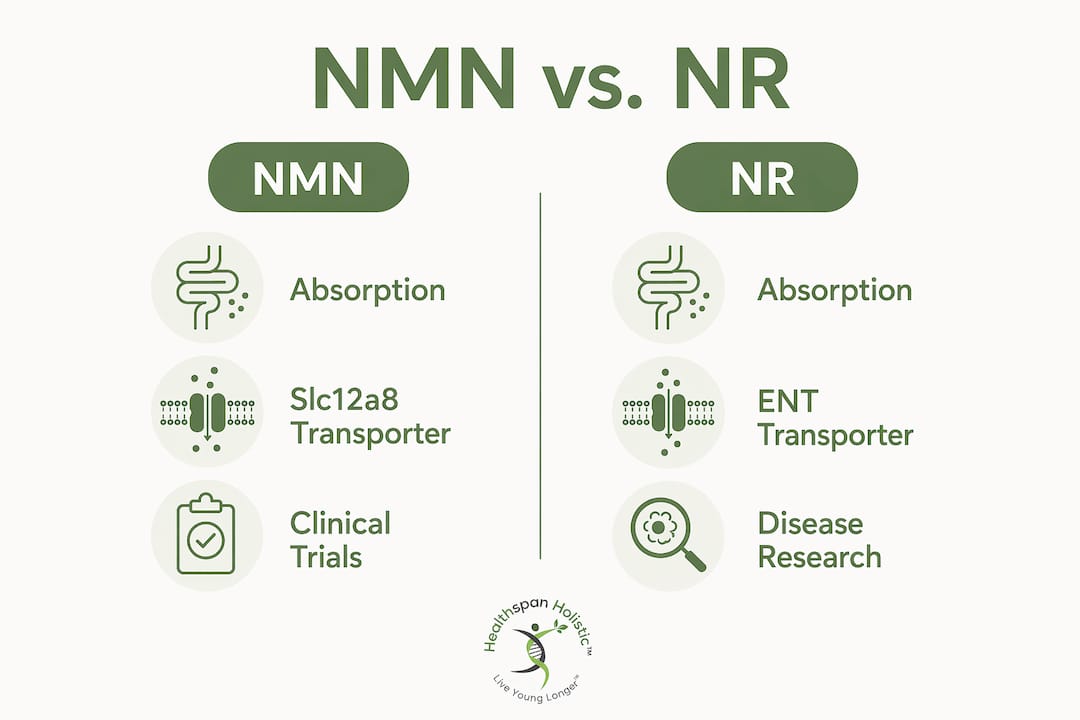
NMN and NR differ in their biochemical pathways and in the volume of clinical trial evidence behind them. NR uses the ENT (equilibrative nucleoside transporter) family for absorption, while NMN uses the Slc12a8 transporter. Both reliably raise blood NAD+, but neither has proven superiority over the other in head-to-head human trials.
Where NR currently has an edge is in disease-focused research. More clinical trials have studied NR in specific patient populations, including people with heart failure, Parkinson’s disease, and metabolic syndrome. NMN has a growing body of healthy aging and performance research but fewer disease-specific trials. For a healthy adult over 45 focused on vitality and longevity, that distinction matters less than it would for someone managing a specific condition.
Here is a practical side-by-side comparison:
| Factor | NMN | NR |
|---|---|---|
| Absorption pathway | Slc12a8 transporter | ENT family transporters |
| NAD+ elevation | Confirmed in humans | Confirmed in humans |
| Disease trial volume | Lower | Higher |
| Typical dose range | 250 to 1,000 mg/day | 250 to 1,000 mg/day |
| Short-term safety | Excellent | Excellent |
| Cost | Generally higher | Generally lower |
When choosing between them, consider evidence-based supplement options that match your specific health goals. Product purity matters significantly for both. Look for supplements that carry third-party testing certification from organizations like NSF International or Informed Sport, since the NMN market includes products with inconsistent potency. Neither NMN nor NR is a guaranteed performance enhancer. Both are NAD+ pathway tools that work best within a broader wellness strategy.
Practical guidelines for taking NMN supplements
If you decide NMN is right for you, here is how to approach it thoughtfully.
-
Start with a moderate dose. Human trials show NAD+ elevation with doses between 250 and 900 mg per day, with 600 mg per day appearing to optimize effects in several studies. Doses up to 1,250 mg per day have been well tolerated short-term, but more is not always better. NAD+ elevation does not scale linearly with dose.
-
Take NMN in the morning. NAD+ plays a role in regulating circadian rhythms, and most researchers recommend morning dosing to align with your body’s natural energy cycle. Some people report mild sleep disruption when taking NMN in the evening.
-
Know the safety profile. Short-term safety is excellent, with no serious adverse events reported in trials. However, long-term safety data beyond six months are lacking. A theoretical concern exists around cancer risk because NAD+ supports cell proliferation, but there is no human evidence linking NMN supplementation to cancer. If you have a history of cancer or are on medications, consult your physician before starting.
-
Test your baseline before you begin. Your response to NMN depends partly on where your NAD+ and metabolic markers start. Exploratory analyses from the 2026 endurance RCT showed that benefits appeared primarily in subgroups with higher baseline NAD+ status, suggesting that your starting point shapes your outcome.
-
Combine NMN with lifestyle factors. Nutrition, resistance training, and quality sleep all influence NAD+ metabolism independently. NMN works best as a complement to these habits, not a replacement for them. Adults who exercise regularly and eat nutrient-dense diets appear to get more from NAD+ boosters than sedentary individuals.
Pro Tip: Some researchers suggest combining NMN with resveratrol or pterostilbene, which activate sirtuins downstream of NAD+. The combination targets the same longevity pathway from two directions. Look for products that include both, or stack them intentionally.
Key takeaways
NMN reliably raises blood NAD+ levels in humans, but functional benefits for vitality and longevity depend on your individual metabolic context, dose, and lifestyle integration.
| Point | Details |
|---|---|
| NAD+ elevation is confirmed | Oral NMN consistently raises blood NAD+ across multiple human RCTs at doses of 250 to 900 mg per day. |
| Functional benefits remain inconsistent | Most trials are too small and short to confirm meaningful improvements in energy, metabolism, or performance. |
| Personalization matters | Your baseline NAD+ status and metabolic health shape how much benefit you will experience from supplementation. |
| NMN vs. NR is a close call | Both raise NAD+ effectively; NR has more disease-focused trials, NMN has a dedicated absorption transporter. |
| Safety is good short-term | No serious adverse events have been reported, but data beyond six months are limited. |
My honest perspective on NMN and realistic expectations
I have spent years reviewing longevity supplement research, and NMN is one of the most biochemically compelling compounds I have come across for adults over 45. The NAD+ decline that happens with aging is real, measurable, and consequential. NMN addresses it through a well-understood pathway. That is not marketing. That is established biology.
What I push back on is the expectation that NMN alone will restore the energy of your 30s. The clinical outcomes in middle-aged and older adults are inconsistent, and the trials we have are simply not long enough or large enough to tell us what happens over two or three years of supplementation. That uncertainty is honest, and I think it is worth naming clearly.
What I have found most useful is thinking about NMN as a foundation layer, not a fix. When you combine it with regular exercise, quality sleep, and targeted nutrition, you are giving your mitochondria multiple reasons to perform better. NMN adds fuel to a system that is already being maintained. Without the lifestyle context, you are likely raising a number on a lab test without changing how you feel day to day.
The adults I see getting the most from NMN are those who have tested their baseline metabolic markers, understand where their gaps are, and use supplementation as one piece of a larger strategy. That approach, grounded in data and personalized to your biology, is what separates meaningful healthspan improvement from expensive guesswork.
— Chris
Personalize your NMN strategy with lab testing
Before you invest in NMN supplements, knowing your baseline NAD, metabolic and nutrient status gives you a significant advantage. At Healthspan Holistic, we offer targeted lab tests that reveal exactly where your body needs support. The Metabolic Panel shows how your cells are processing energy, while the Cellular Micronutrient Test identifies nutrient gaps that affect how well NAD+ boosters work for you. You can also check mineral status with the Magnesium RBC Test, since magnesium is a co-factor in over 300 enzymatic reactions including NAD+ synthesis. Testing first means supplementing smarter.
1st Time Customers can take advantage of our BUY 1 GET 1 50% OFF special offer on all supplements.
Explore our full supplement collection at Healthspan Holistic and find the right support for your vitality goals.
FAQ
What is nicotinamide mononucleotide used for?
Nicotinamide mononucleotide is used primarily to raise NAD+ levels in the body, supporting cellular energy production, DNA repair, and longevity pathways that decline with age. It is most commonly taken by adults over 40 as part of a vitality and healthy aging strategy.
What is the recommended NMN dosage for adults?
Human trials show effective NAD+ elevation at doses between 250 and 900 mg per day, with 600 mg per day appearing to optimize results in several studies. Doses up to 1,250 mg per day have been well tolerated short-term, though more is not necessarily more effective.
Is NMN safe to take long-term?
Short-term safety is well established, with no serious adverse events reported in clinical trials. Long-term safety data beyond six months are currently limited, so adults with cancer history or those on medications should consult a physician before starting NMN.
How does NMN differ from nicotinamide riboside (NR)?
NMN uses the Slc12a8 intestinal transporter for absorption, while NR uses the ENT transporter family. Both raise blood NAD+ effectively, but NR has more disease-focused clinical trial data and is generally less expensive, while NMN has a growing body of healthy aging research.
How long does it take to feel the effects of NMN?
Blood NAD+ levels typically rise within two to four weeks of consistent NMN supplementation. Subjective effects on energy or vitality vary widely and depend on your baseline NAD+ status, lifestyle habits, and overall metabolic health.
Leave a comment: